
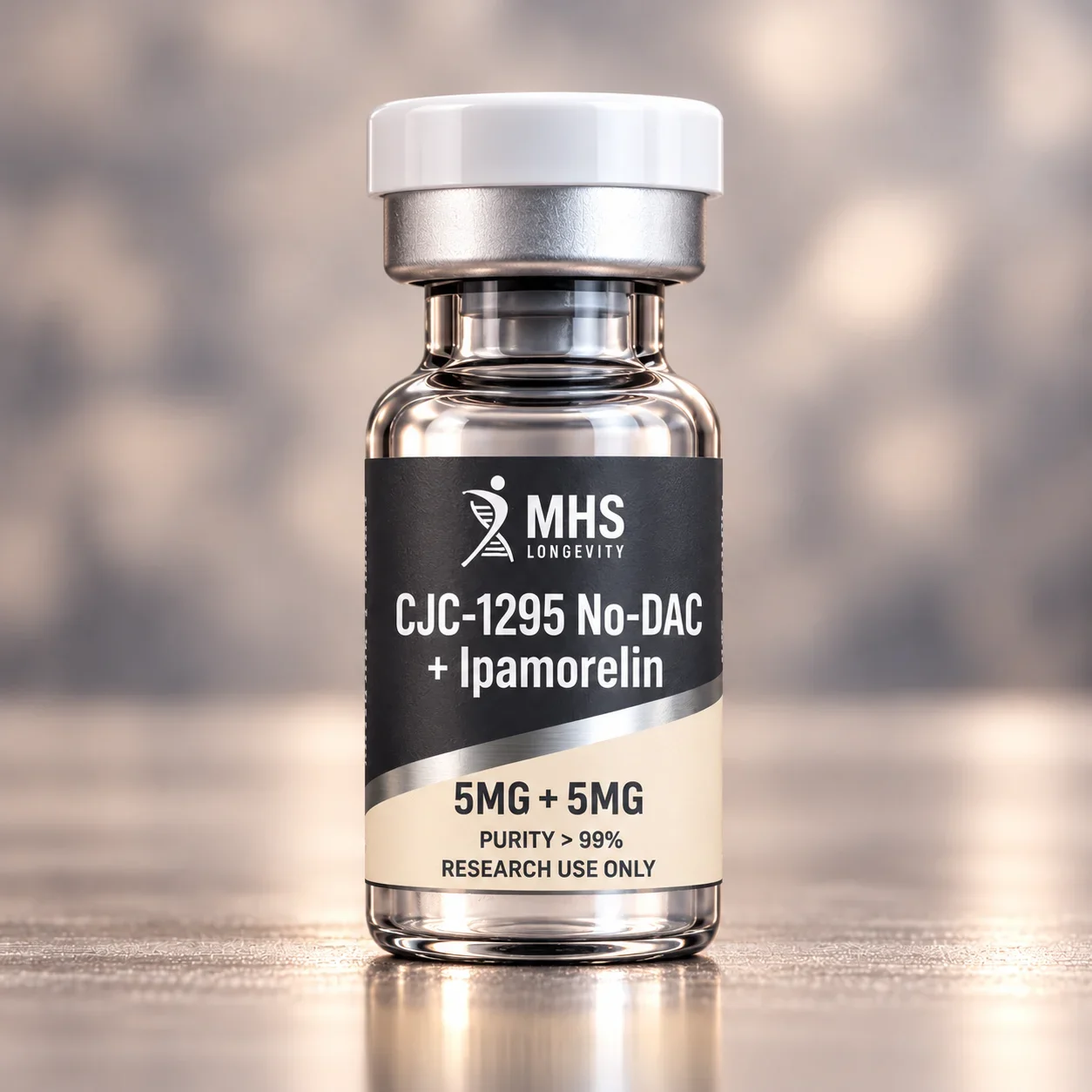
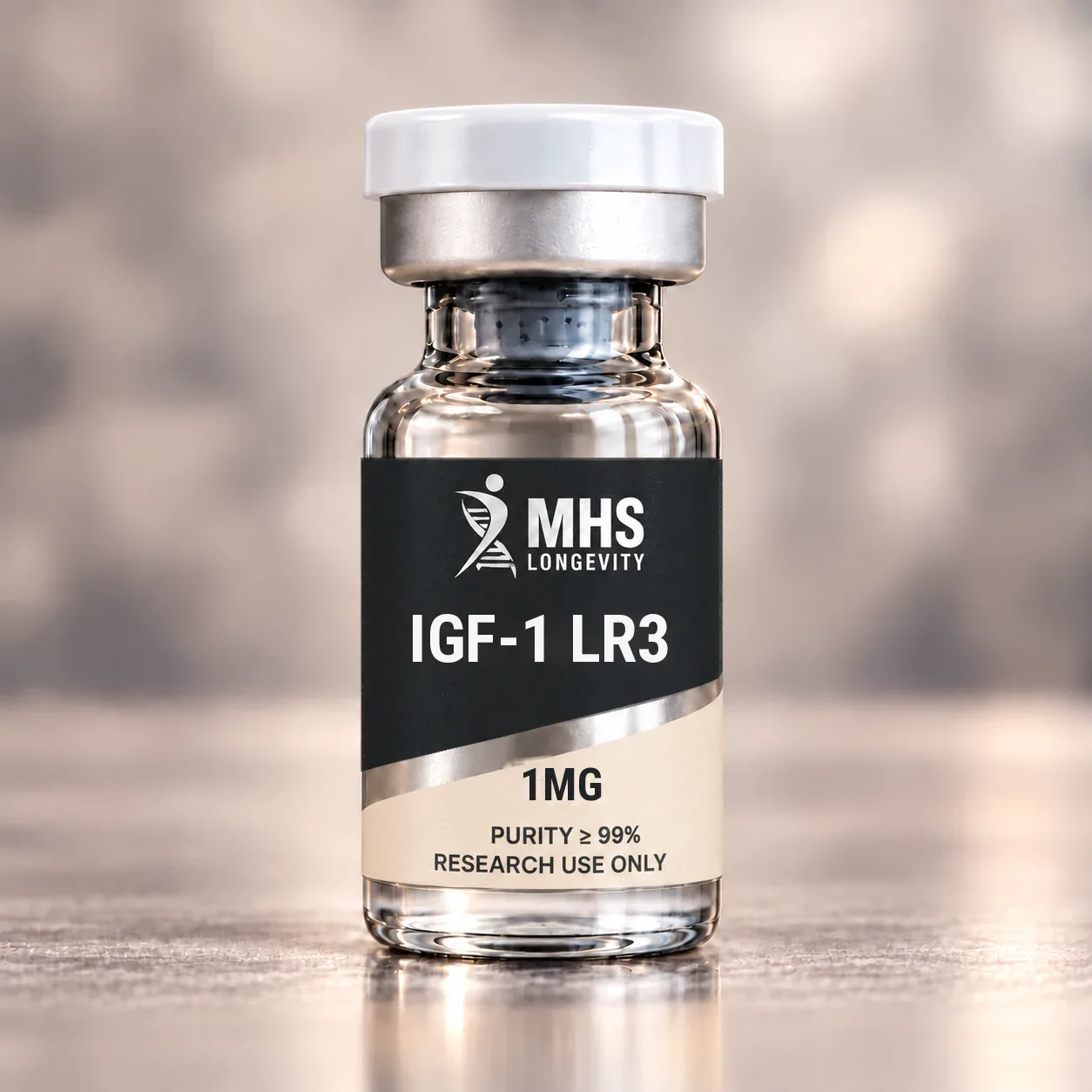
IGF-1 LR3 1mg
A regenerative research peptide associated with muscle growth signaling, cellular repair, and recovery pathways.
- 99%+ purity verified by independent HPLC + Mass Spec
- Certificate of Analysis published — match it to your vial
- Ships from US facility · Free shipping over $150
$119.99
In stock — ships within 24h
For laboratory research use only. Not for human consumption.
Storage & handling+
Lyophilized IGF-1 LR3 should be stored at -20°C or below for extended stability. Once reconstituted, the solution is typically held at 2–8°C and used within the documented stability window. Folded, disulfide-bonded peptides like IGF-1 LR3 are more sensitive than smaller linear peptides to pH extremes, reducing agents, and prolonged storage in solution — single-use aliquoting is good practice. Standard aseptic technique applies during reconstitution. For laboratory research use only.
Shipping & delivery+
Orders placed before 2pm ET ship the same business day from our US facility. Standard (2–4 days) or expedited options available. Free standard US shipping on orders over $150. Plain, unbranded packaging. Full shipping policy
Returns & damage policy+
Damaged or non-conforming orders are reshipped at no cost — contact support with a photo within 7 days of delivery. See our full returns policy for details. Full returns policy
We accept


Used in Muscle Growth Protocol.
HPLC tested
99%+ purity verified
Public COAs
Third-party certificates
Veteran-owned
US-based fulfillment
Free shipping
On orders over $150
Overview
Description
A regenerative research peptide associated with muscle growth signaling, cellular repair, and recovery pathways. Typically selected for advanced performance research and post-injury recovery models.
IGF-1 LR3 is often chosen when the goal is stronger anabolic signaling support in research settings, with an emphasis on tissue recovery and lean mass–related pathways.
Scientific Overview
IGF-1 LR3 (Insulin-like Growth Factor-1 Long R3) is a synthetic analog engineered for an extended half-life through structural modification. It has been studied for interaction with IGF-1 receptors and downstream anabolic signaling, including muscle hypertrophy and tissue regeneration pathways in laboratory models. Research also evaluates its relationship to metabolic regulation and recovery mechanisms.
Product Details
- Compound: IGF-1 LR3 (Insulin-like Growth Factor-1 Long R3)
- Vial Size: 1mg
- Purity: ≥99%
- Form: Lyophilized powder
This product is intended strictly for laboratory research purposes only. It is not approved for human or veterinary use by the FDA or any other regulatory agency. Store in a cool, dry environment prior to reconstitution and handle using appropriate laboratory and aseptic techniques.
Frequently asked questions
Yes. Every batch of IGF-1 LR3 1mg undergoes independent third-party testing using High-Performance Liquid Chromatography (HPLC) and Mass Spectrometry (MS). The Certificate of Analysis is published and accessible from the product page.
IGF-1 LR3 1mg sold by MHS Longevity is verified to 99%+ purity, with the result documented in each batch's Certificate of Analysis. Anything below that threshold is rejected before release.
The Certificate of Analysis for IGF-1 LR3 1mg is available directly from the product page and on our Third-Party Test Results page. Each COA includes the batch identifier, test date, testing method, and verified purity percentage.
IGF-1 LR3 1mg ships from our US-based facility with standard or expedited options. Orders over $150 qualify for free standard US shipping. All orders are packaged discreetly with documented handling protocols.
No. IGF-1 LR3 1mg is supplied strictly for laboratory research purposes only. It is not approved by the FDA for human or veterinary use, and it is not intended to diagnose, treat, cure, or prevent any disease.
MHS Longevity is a veteran-owned operation focused on pharmaceutical-grade research compounds. We source from vetted manufacturers, batch-test independently with HPLC and Mass Spectrometry, and publish every Certificate of Analysis. Pricing is transparent and the testing process is documented end-to-end.
IGF-1 LR3 has a molecular weight of approximately 9117.7 g/mol. The empirical formula and exact monoisotopic mass are documented on each batch's Certificate of Analysis alongside the Mass Spectrometry result confirming the disulfide bonds are correctly formed.
Native IGF-1 is a 70-amino-acid peptide. IGF-1 LR3 carries two engineered changes: a 13-amino-acid N-terminal extension and a glutamate-to-arginine substitution at position 3. Together these reduce binding affinity for IGFBP-3, so a higher fraction of administered LR3 remains free in serum and available for receptor binding compared to equivalent native IGF-1.
IGF-1 LR3 is sent to an independent third-party laboratory for HPLC and Mass Spectrometry analysis before each batch is released. The lab's identifier and test date are published on the Certificate of Analysis for that batch, including the mass shift that confirms the disulfide architecture is in place.
Native IGF-1's biological activity depends on three intramolecular disulfide bonds that lock its tertiary structure. IGF-1 LR3 preserves this disulfide architecture; without correct folding, the molecule would not bind the IGF-1 receptor productively. Mass Spectrometry confirms the oxidized (correctly-folded) state by detecting the mass shift relative to the reduced (open-disulfide) form.
You may also like
Research & buying
The evidence behind IGF-1 LR3 1mg and the questions to ask any vendor before you order.
Research details — IGF-1 LR3 1mg
IGF-1 LR3 is a synthetic analogue of insulin-like growth factor 1 modified for extended in-vivo activity and reduced binding to IGF binding proteins (IGFBPs). The molecule extends native IGF-1's 70-residue sequence with a 13-amino-acid N-terminal extension (the 'long' in LR3) and substitutes arginine for glutamate at position 3 (the 'R3'). Together those two modifications produce a peptide with substantially altered pharmacokinetics — particularly weaker binding to IGFBP-3, which keeps more of the administered molecule biologically free. This guide explains what IGF-1 LR3 is, the published research context, and how its quality is independently verified.
What is IGF-1 LR3?
IGF-1 LR3 is an 83-amino-acid synthetic peptide stabilized by three intramolecular disulfide bonds that mirror native IGF-1's tertiary structure. The molecular weight is approximately 9117.7 g/mol — substantially larger than most peptides we stock. The N-terminal 13-residue extension reads Met-Phe-Pro-Ala-Met-Pro-Leu-Ser-Ser-Leu-Phe-Val-Asn-, after which the IGF-1 sequence begins with the position-3 Arg substitution. It is supplied as a lyophilized white powder for laboratory reconstitution.
Research context
Published research on IGF-1 LR3 centers on its use as a long-acting IGF-1 receptor agonist in models that need sustained pharmacology. The combination of the N-terminal extension and the Arg3 substitution reduces affinity for IGFBP-3 (the major serum IGF binding protein), so a larger fraction of administered LR3 remains free and biologically active relative to native IGF-1 in similar conditions. This pharmacokinetic profile makes LR3 useful in research that needs to separate receptor-direct effects from IGFBP-mediated modulation, including in muscle-cell, hepatocyte, and neuronal-culture systems. Researchers should evaluate the primary literature on IGF-1 receptor signaling and note that comparative work using native IGF-1 and LR3 produces meaningfully different in-vivo results.
How IGF-1 LR3 quality is verified
IGF-1 LR3 is among the more complex peptides in research circulation — 83 amino acids, three disulfide bonds that must be formed in the correct topology during oxidative folding, and a non-native N-terminal extension. Quality verification accordingly has multiple layers:
- HPLC separates components by chemistry. For folded peptides of this length, the chromatogram is the primary readout for misfolded or scrambled-disulfide species — these elute at different retention times from the correctly-folded molecule. Anything below 99% is rejected.
- Mass Spectrometry confirms the 83-residue mass corresponds to the full LR3 sequence. The correctly folded form has a slightly lower mass than the reduced (linear, free-thiol) form due to the loss of six hydrogens during oxidative disulfide formation — a clean MS readout that confirms the disulfide architecture is in place.
What an IGF-1 LR3 Certificate of Analysis shows
- Compound name and structural designation. IGF-1 LR3, with the full 83-amino-acid sequence and notation of the three intramolecular disulfide bonds.
- Batch identifier. Unique ID linking certificate to vial.
- Test date. When the analysis was performed.
- Method. HPLC, MS, or both, with column and mobile-phase notes.
- Verified purity %. The HPLC result. We require 99%+.
- Disulfide-bond confirmation. MS mass shift (vs reduced form) confirms the three disulfide bonds are in place.
- Lab and signatures. The independent lab performing the analysis.
Storage and handling (research lab context)
Lyophilized IGF-1 LR3 should be stored at -20°C or below for extended stability. Once reconstituted, the solution is typically held at 2–8°C and used within the documented stability window. Folded, disulfide-bonded peptides like IGF-1 LR3 are more sensitive than smaller linear peptides to pH extremes, reducing agents, and prolonged storage in solution — single-use aliquoting is good practice. Standard aseptic technique applies during reconstitution.
Where to buy IGF-1 LR3 1mg
The same eight questions apply whether you're buying IGF-1 LR3 1mg from us or anywhere else. Vendors who can't answer any of them are worth a closer look.
Vendor evaluation checklist
1. Is the Certificate of Analysis public and downloadable?
A vendor unwilling to publish HPLC/MS results for the batch you're buying has nothing to verify their purity claim against.
2. Which testing method was used — HPLC, Mass Spectrometry, or both?
HPLC measures purity. Mass Spectrometry confirms the molecule's identity. Reputable batches go through both.
3. What's the verified purity percentage on the published COA?
Industry research standard is 99%+. Below that, you're paying for a compound diluted with synthesis byproducts.
4. Where does the product ship from?
US-based fulfillment generally means shorter handling times, customs-free delivery, and clearer return remedies.
5. Is the price published at a single list rate, or hidden behind tier locks?
Opaque pricing is a yellow flag. Transparent vendors quote the same number to every customer.
6. What's the free-shipping threshold, if any?
Compare the all-in cost (product + shipping + handling) — not just the headline price.
7. How is the product stored prior to shipment?
Lyophilized peptides degrade with temperature swings. Vendors should disclose temperature-controlled storage.
8. Is there a documented damage-claim and return policy?
Discreet shipping carries handling risk. A clear, written policy protects you when something goes wrong.
MHS LongevityThis site - Price
- $119.99
- Purity
- 99%+
- Testing
- HPLC + MS
- COA public
- US-based
- Free shipping
- $150+
- Last checked
- Oct 10, 2026
| Vendor | Price | Listed purity | Testing method | COA public | US-based | Free shipping | Last checked |
|---|---|---|---|---|---|---|---|
MHS LongevityThis site | $119.99 | 99%+ | HPLC + MS | $150+ | Oct 10, 2026 |
Competitor data sourced from each vendor's public product page on the date shown. Listed purity reflects each vendor's own published claim; Certificate of Analysis availability is verified at the URL above. Data may have changed since last check.