
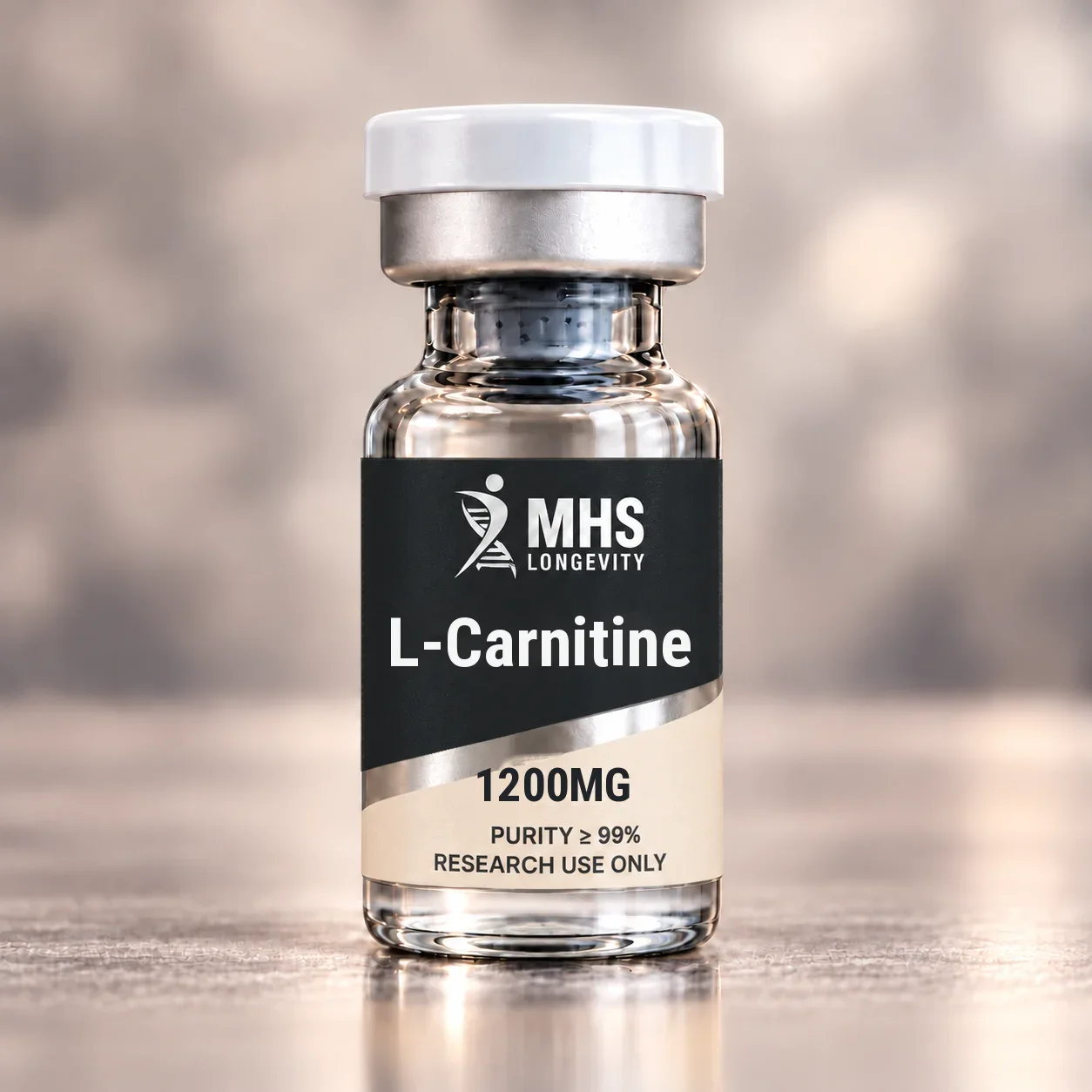
L-Carnitine 1200mg
A metabolic support compound researched for helping transport fat into cells to be used for energy.
- 99%+ purity verified by independent HPLC + Mass Spec
- Certificate of Analysis published — match it to your vial
- Ships from US facility · Free shipping over $150
$79.99
In stock — ships within 24h
For laboratory research use only. Not for human consumption.
Storage & handling+
Shipping & delivery+
Returns & damage policy+
We accept


HPLC tested
99%+ purity verified
Public COAs
Third-party certificates
Veteran-owned
US-based fulfillment
Free shipping
On orders over $150
Overview
Description
A metabolic support compound researched for helping transport fat into cells to be used for energy. Often chosen for endurance support, training output, and improved metabolic flexibility.
L-Carnitine is commonly explored in research for cellular energy efficiency and fat-oxidation pathways— making it a practical option in performance and body-composition programs.
Scientific Overview
L-Carnitine is a naturally occurring compound involved in shuttling long-chain fatty acids into mitochondria for beta-oxidation. Research evaluates its role in energy metabolism, exercise performance models, and cellular fuel utilization pathways. Outcomes depend on experimental design and metabolic context.
Product Details
- Compound: L-Carnitine
- Amount: 1200mg (as listed)
- Form: Solution (as listed)
This product is intended strictly for laboratory research purposes only. It is not approved for human or veterinary use by the FDA or any other regulatory agency. Store as directed on the label and handle using appropriate laboratory and aseptic techniques.
Frequently asked questions
Yes. Every batch of L-Carnitine 1200mg undergoes independent third-party testing using High-Performance Liquid Chromatography (HPLC) and Mass Spectrometry (MS). The Certificate of Analysis is published and accessible from the product page.
L-Carnitine 1200mg sold by MHS Longevity is verified to 99%+ purity, with the result documented in each batch's Certificate of Analysis. Anything below that threshold is rejected before release.
The Certificate of Analysis for L-Carnitine 1200mg is available directly from the product page and on our Third-Party Test Results page. Each COA includes the batch identifier, test date, testing method, and verified purity percentage.
L-Carnitine 1200mg ships from our US-based facility with standard or expedited options. Orders over $150 qualify for free standard US shipping. All orders are packaged discreetly with documented handling protocols.
No. L-Carnitine 1200mg is supplied strictly for laboratory research purposes only. It is not approved by the FDA for human or veterinary use, and it is not intended to diagnose, treat, cure, or prevent any disease.
MHS Longevity is a veteran-owned operation focused on pharmaceutical-grade research compounds. We source from vetted manufacturers, batch-test independently with HPLC and Mass Spectrometry, and publish every Certificate of Analysis. Pricing is transparent and the testing process is documented end-to-end.
No. L-Carnitine is a quaternary ammonium small molecule biosynthesized from the amino acids lysine and methionine in the body. It does not contain a peptide backbone and is not produced by peptide synthesis. The same independent HPLC and Mass Spectrometry methods used for peptide research apply here, with the addition of chiral analysis specific to verifying the L-enantiomer.
L-Carnitine has a molecular weight of approximately 161.2 g/mol with the empirical formula C7H15NO3. This is documented on each batch's Certificate of Analysis alongside the optical-rotation value confirming L-stereochemistry.
Only L-Carnitine is biologically active in mitochondrial fatty-acid transport. The D-enantiomer cannot serve as a substrate for carnitine palmitoyltransferase and at higher concentrations can compete with L-Carnitine for transport, potentially producing the opposite of the intended research effect. Quality verification therefore requires confirmation of L-enantiomer predominance — chemical purity alone is not sufficient.
L-Carnitine is sent to an independent third-party laboratory for HPLC, chiral analysis, and Mass Spectrometry before each batch is released. The lab's identifier, test date, total purity, and optical-rotation or chiral-HPLC result confirming L-stereochemistry are published on the Certificate of Analysis for that batch.
Research & buying
The evidence behind L-Carnitine 1200mg and the questions to ask any vendor before you order.
Research details — L-Carnitine 1200mg
L-Carnitine is a small-molecule research compound — not a peptide. It is a quaternary ammonium amino-acid derivative essential for the transport of long-chain fatty acids across the mitochondrial inner membrane for β-oxidation. The molecule was identified in muscle tissue in the 1900s and has been a research staple in mitochondrial metabolism ever since. We supply L-Carnitine because the longevity-research community studies it alongside other mitochondrial-targeted compounds like MOTS-C and SS-31; the same independent third-party testing discipline we apply to peptides applies here. This guide explains what L-Carnitine is, the research context, and how its quality is independently verified.
What is L-Carnitine?
L-Carnitine is (R)-3-hydroxy-4-(trimethylammonio)butanoate, a quaternary ammonium compound with the empirical formula C7H15NO3 and a molecular weight of approximately 161.2 g/mol. The 'L' designates the biologically active enantiomer; the D-enantiomer is essentially inactive and at higher concentrations can competitively inhibit L-Carnitine transport — making L-stereochemistry verification an essential quality criterion. It is supplied as a hygroscopic crystalline solid for laboratory reconstitution.
L-Carnitine is sold strictly for laboratory and research use. It is not approved by the FDA or any other regulatory body for human or veterinary use in this form, and nothing in this guide constitutes guidance for human administration.
Research context
Published research on L-Carnitine centers on its role as the obligatory shuttle molecule in mitochondrial fatty-acid β-oxidation. Long-chain fatty acids cannot cross the mitochondrial inner membrane unaided; they must be esterified to L-Carnitine on the outer side by carnitine palmitoyltransferase I (CPT1), translocated across the inner membrane by the carnitine-acylcarnitine translocase, then de-esterified on the matrix side by CPT2. Without L-Carnitine, mitochondrial fatty-acid metabolism halts. The molecule is studied across cardiac, skeletal-muscle, and hepatic contexts where fatty-acid oxidation is the dominant energy pathway, and in metabolic-disease research where carnitine-pool dynamics shift. Researchers should evaluate primary sources in their specific subfield directly.
How L-Carnitine quality is verified
L-Carnitine quality verification has a stereochemistry component that does not appear for most other small molecules. Every batch of MHS Longevity L-Carnitine is submitted to an independent third-party laboratory before release:
- HPLC separates components by chemistry and measures total Carnitine content. Anything below 99% is rejected. Note that standard reversed-phase HPLC does not separate the L- and D-enantiomers from each other — both have identical chemistry except stereochemistry — so a chiral analytical method is required for that specific determination.
- Chiral analysis (typically chiral HPLC or optical rotation) confirms the L-enantiomer dominance. The specific optical rotation of pure L-Carnitine is well-characterized; deviation from the expected value flags D-enantiomer contamination.
- Mass Spectrometry confirms the mass and rules out structurally related impurities (acetyl-L-Carnitine, propionyl-L-Carnitine, or trimethylaminobutyrate precursors).
What an L-Carnitine Certificate of Analysis shows
- Compound name and structural designation. L-Carnitine ((R)-3-hydroxy-4-(trimethylammonio)butanoate), with molecular formula and optical-rotation value.
- Batch identifier. Unique ID linking certificate to vial.
- Test date. When the analysis was performed.
- Method. HPLC, chiral analysis, and MS, with method notes where relevant.
- Verified purity %. The HPLC result. We require 99%+.
- L-stereochemistry confirmation. Optical-rotation or chiral-HPLC result confirming L-enantiomer predominance.
- Lab and signatures. The independent lab performing the analysis.
Storage and handling (research lab context)
L-Carnitine as a crystalline solid is more thermally stable than most peptides — room-temperature storage of the sealed solid is acceptable, though refrigerated storage extends shelf life. The compound is hygroscopic and will absorb atmospheric moisture if left exposed; tightly sealed containers and minimal exposure to humid air preserve dry-state stability. Reconstituted solutions are typically held at 2–8°C and used within the documented stability window. Standard handling precautions for small-molecule research compounds apply.
Where to buy L-Carnitine 1200mg
The same eight questions apply whether you're buying L-Carnitine 1200mg from us or anywhere else. Vendors who can't answer any of them are worth a closer look.
Vendor evaluation checklist
1. Is the Certificate of Analysis public and downloadable?
A vendor unwilling to publish HPLC/MS results for the batch you're buying has nothing to verify their purity claim against.
2. Which testing method was used — HPLC, Mass Spectrometry, or both?
HPLC measures purity. Mass Spectrometry confirms the molecule's identity. Reputable batches go through both.
3. What's the verified purity percentage on the published COA?
Industry research standard is 99%+. Below that, you're paying for a compound diluted with synthesis byproducts.
4. Where does the product ship from?
US-based fulfillment generally means shorter handling times, customs-free delivery, and clearer return remedies.
5. Is the price published at a single list rate, or hidden behind tier locks?
Opaque pricing is a yellow flag. Transparent vendors quote the same number to every customer.
6. What's the free-shipping threshold, if any?
Compare the all-in cost (product + shipping + handling) — not just the headline price.
7. How is the product stored prior to shipment?
Lyophilized peptides degrade with temperature swings. Vendors should disclose temperature-controlled storage.
8. Is there a documented damage-claim and return policy?
Discreet shipping carries handling risk. A clear, written policy protects you when something goes wrong.
MHS LongevityThis site - Price
- $79.99
- Purity
- 99%+
- Testing
- HPLC + MS
- COA public
- US-based
- Free shipping
- $150+
- Last checked
- Oct 10, 2026
| Vendor | Price | Listed purity | Testing method | COA public | US-based | Free shipping | Last checked |
|---|---|---|---|---|---|---|---|
MHS LongevityThis site | $79.99 | 99%+ | HPLC + MS | $150+ | Oct 10, 2026 |
Competitor data sourced from each vendor's public product page on the date shown. Listed purity reflects each vendor's own published claim; Certificate of Analysis availability is verified at the URL above. Data may have changed since last check.