
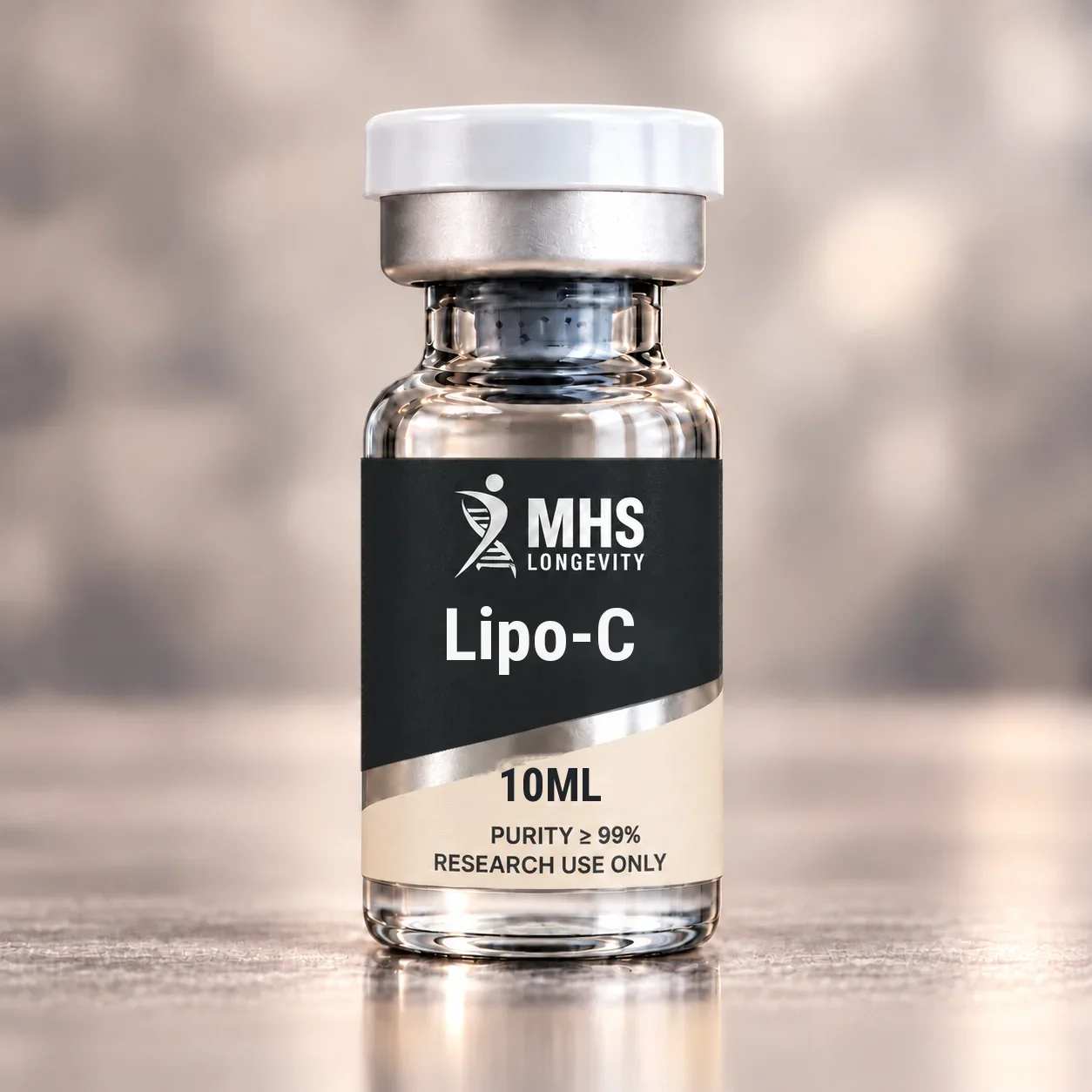
Lipo-C 10mL
A metabolic support blend researched for energy support and fat-metabolism pathways.
- 99%+ purity verified by independent HPLC + Mass Spec
- Certificate of Analysis published — match it to your vial
- Ships from US facility · Free shipping over $150
$79.99
In stock — ships within 24h
For laboratory research use only. Not for human consumption.
- Purity (HPLC)
- >99%
- Method
- HPLC + MS
Storage & handling+
Shipping & delivery+
Returns & damage policy+
We accept


HPLC tested
99%+ purity verified
Public COAs
Third-party certificates
Veteran-owned
US-based fulfillment
Free shipping
On orders over $150
Overview
Description
A metabolic support blend researched for energy support and fat-metabolism pathways. Often selected when a stacked, multi-nutrient approach is preferred over a single compound.
Lipo-C is commonly used in metabolic-optimization research as a supportive foundation— especially in protocols focused on energy output and nutrient partitioning.
Scientific Overview
Lipo-C is typically formulated as a lipotropic blend and studied for roles in methylation support, lipid metabolism, and energy-related cofactor pathways. Exact scientific relevance depends on the specific ingredient profile and concentrations. Common formulations include choline, inositol, methionine, and B-vitamin components in solution form.
Product Details
- Product: Lipo-C (Lipotropic Blend)
- Vial Size: 10mL
- Form: Solution (as listed)
This product is intended strictly for laboratory research purposes only. It is not approved for human or veterinary use by the FDA or any other regulatory agency. Store as directed on the label and handle using appropriate laboratory and aseptic techniques.
Frequently asked questions
Yes. Every batch of Lipo-C 10mL undergoes independent third-party testing using High-Performance Liquid Chromatography (HPLC) and Mass Spectrometry (MS). The Certificate of Analysis is published and accessible from the product page.
Lipo-C 10mL sold by MHS Longevity is verified to 99%+ purity, with the result documented in each batch's Certificate of Analysis. Anything below that threshold is rejected before release.
The Certificate of Analysis for Lipo-C 10mL is available directly from the product page and on our Third-Party Test Results page. Each COA includes the batch identifier, test date, testing method, and verified purity percentage.
Lipo-C 10mL ships from our US-based facility with standard or expedited options. Orders over $150 qualify for free standard US shipping. All orders are packaged discreetly with documented handling protocols.
No. Lipo-C 10mL is supplied strictly for laboratory research purposes only. It is not approved by the FDA for human or veterinary use, and it is not intended to diagnose, treat, cure, or prevent any disease.
MHS Longevity is a veteran-owned operation focused on pharmaceutical-grade research compounds. We source from vetted manufacturers, batch-test independently with HPLC and Mass Spectrometry, and publish every Certificate of Analysis. Pricing is transparent and the testing process is documented end-to-end.
No. Lipo-C is a multi-component formulation of small-molecule and vitamin compounds — methionine, inositol, choline, and typically B12 — none of which are peptides. The 'lipotropic' designation refers to the formulation's research focus on hepatic lipid handling, not to peptide pharmacology.
The components of Lipo-C are all individually soluble and stable in aqueous formulation at the standard lipotropic concentrations, so lyophilization is unnecessary. Liquid formulation also means no user reconstitution step, which is one fewer source of inter-experiment variability for blend products.
Most commonly, cobalamin — vitamin B12. The naming convention varies across the broader lipotropic-formulation space, but the C-with-B12 reading is the predominant one. The specific composition of any given batch is documented on its Certificate of Analysis.
Lipo-C is sent to an independent third-party laboratory for per-component HPLC analysis, Mass Spectrometry confirmation, and sterile-liquid USP-aligned testing (sterility, endotoxin, particulates, pH) before each batch is released. The lab's identifier, test date, and verified concentrations are published on the Certificate of Analysis for that batch.
Research & buying
The evidence behind Lipo-C 10mL and the questions to ask any vendor before you order.
Research details — Lipo-C 10mL
Lipo-C is a liquid lipotropic formulation supplied at 10ml per vial for laboratory research. Lipotropic blends are mixtures of methyl-donor and lipid-mobilization compounds — typically methionine, inositol, choline, and (depending on the specific formulation) vitamin B12 — that have been studied for decades in hepatic fatty-acid metabolism research. Unlike most of our catalog, Lipo-C is supplied as a ready-to-use liquid rather than a lyophilized solid, which changes both the storage and the quality-verification considerations. This guide explains what Lipo-C is, the research-pathway context, and how each batch is independently verified.
What is Lipo-C?
Lipo-C is a multi-component liquid formulation in the lipotropic family. The standard lipotropic core consists of methionine (a sulfur-containing amino acid and methyl donor), inositol (a six-carbon sugar alcohol involved in phospholipid synthesis), and choline (a quaternary ammonium compound and precursor to phosphatidylcholine). Many lipotropic formulations also include cyanocobalamin (vitamin B12) — the 'C' in Lipo-C is most commonly read as referring to cobalamin. The specific per-component concentrations are documented on each batch's Certificate of Analysis. The formulation is supplied as a clear-to-pink-tinged liquid in a 10ml vial.
Lipo-C is sold strictly for laboratory and research use. It is not approved by the FDA or any other regulatory body for human or veterinary use in this form, and nothing in this guide constitutes guidance for human administration.
Research context
Published research on lipotropic formulations spans hepatic fatty-acid metabolism, methyl-donor pool dynamics, and phospholipid biosynthesis. Each component carries its own substantial individual literature — methionine as the dominant entry point into the S-adenosylmethionine (SAM) methyl-donor pool; inositol as a regulator of inositol-phosphate signaling and phospholipid composition; choline as a precursor to phosphatidylcholine and to acetylcholine. The case for the combined formulation rests on the proposition that these pathways are linked in hepatic lipid handling and that combined supplementation has been studied as a single intervention in animal models of hepatic steatosis. Researchers should evaluate component-specific primary literature alongside any blend-specific work.
How Lipo-C quality is verified
Lipo-C verification is multi-component and liquid-specific. Every batch is submitted to an independent third-party laboratory before release:
- HPLC and/or specific assays for each component measure methionine, inositol, choline, and cobalamin concentrations against the formulation specification. Each component is identified and quantified independently.
- Mass Spectrometry confirms component identities at the molecular level, ruling out compositional errors that could arise from blend-preparation variability.
- USP-aligned testing for sterile-liquid products applies: sterility, particulate matter, pH, and clarity are checked at release because Lipo-C is supplied as a sterile liquid rather than a lyophilized powder reconstituted by the user.
What a Lipo-C Certificate of Analysis shows
- Product name and composition. Lipo-C, with per-component identification (methionine, inositol, choline, and any additional components like cobalamin) and concentrations.
- Batch identifier. Unique ID linking certificate to vial lot.
- Test date. When the analysis was performed.
- Methods. HPLC / component-specific assays + MS + sterile-liquid testing (sterility, endotoxin, particulate matter, pH).
- Verified concentrations. Each component meeting its formulation specification.
- Sterile-liquid release. Sterility, endotoxin, particulate matter all passing USP-aligned criteria.
- Lab and signatures. The independent lab performing the analysis.
Storage and handling (research lab context)
Lipo-C as a sterile liquid is typically stored refrigerated (2–8°C) for the sealed vial, with a documented sealed-vial shelf life printed on the label. After first access of a vial, an in-use stability window applies — typically shorter than for bacteriostatic-water products because Lipo-C contains active components rather than just a solvent. Protect from light during storage; B12 specifically is photosensitive. Standard aseptic technique applies during access.
Where to buy Lipo-C 10mL
The same eight questions apply whether you're buying Lipo-C 10mL from us or anywhere else. Vendors who can't answer any of them are worth a closer look.
Vendor evaluation checklist
1. Is the Certificate of Analysis public and downloadable?
A vendor unwilling to publish HPLC/MS results for the batch you're buying has nothing to verify their purity claim against.
2. Which testing method was used — HPLC, Mass Spectrometry, or both?
HPLC measures purity. Mass Spectrometry confirms the molecule's identity. Reputable batches go through both.
3. What's the verified purity percentage on the published COA?
Industry research standard is 99%+. Below that, you're paying for a compound diluted with synthesis byproducts.
4. Where does the product ship from?
US-based fulfillment generally means shorter handling times, customs-free delivery, and clearer return remedies.
5. Is the price published at a single list rate, or hidden behind tier locks?
Opaque pricing is a yellow flag. Transparent vendors quote the same number to every customer.
6. What's the free-shipping threshold, if any?
Compare the all-in cost (product + shipping + handling) — not just the headline price.
7. How is the product stored prior to shipment?
Lyophilized peptides degrade with temperature swings. Vendors should disclose temperature-controlled storage.
8. Is there a documented damage-claim and return policy?
Discreet shipping carries handling risk. A clear, written policy protects you when something goes wrong.
MHS LongevityThis site - Price
- $79.99
- Purity
- 99%+
- Testing
- HPLC + MS
- COA public
- US-based
- Free shipping
- $150+
- Last checked
- Oct 10, 2026
| Vendor | Price | Listed purity | Testing method | COA public | US-based | Free shipping | Last checked |
|---|---|---|---|---|---|---|---|
MHS LongevityThis site | $79.99 | 99%+ | HPLC + MS | $150+ | Oct 10, 2026 |
Competitor data sourced from each vendor's public product page on the date shown. Listed purity reflects each vendor's own published claim; Certificate of Analysis availability is verified at the URL above. Data may have changed since last check.