

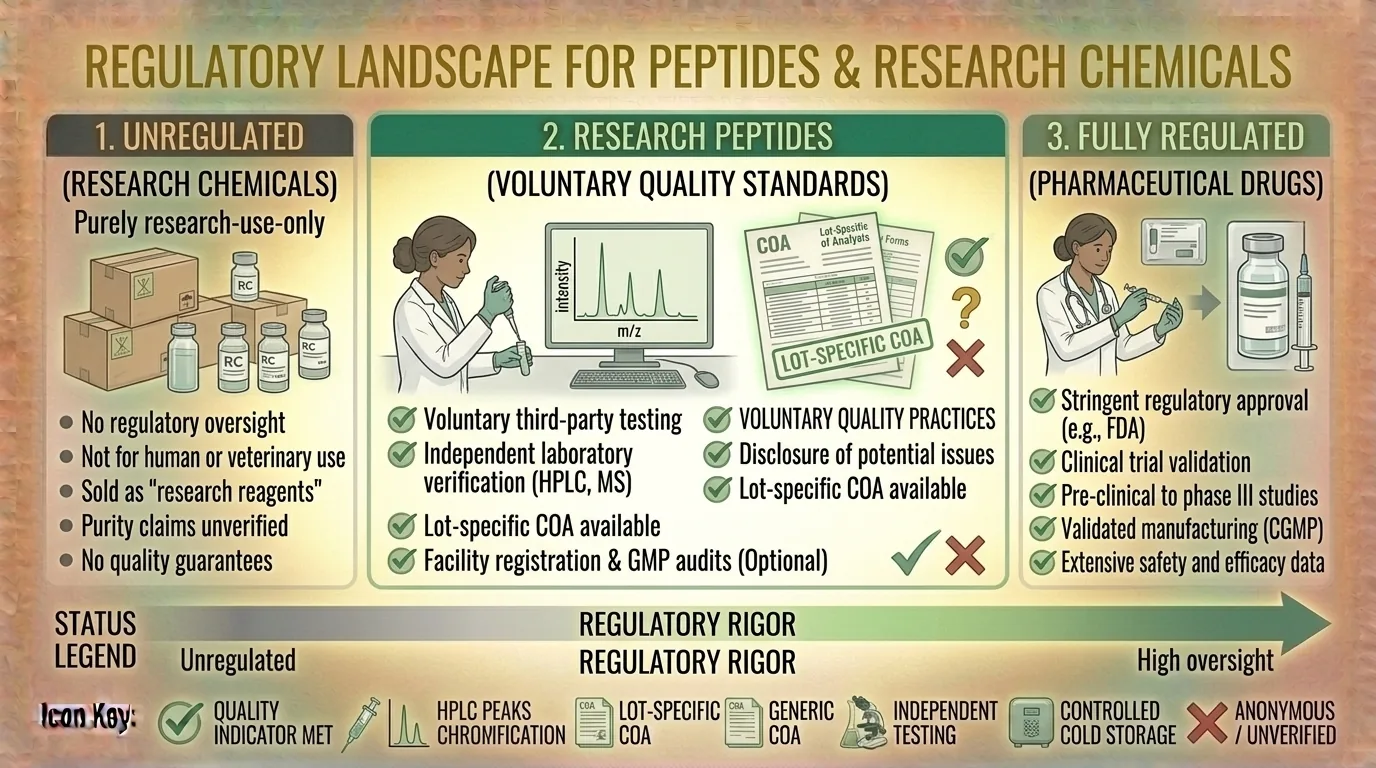
The research peptide industry occupies a distinct position in the regulatory landscape — these compounds are not classified as drugs, supplements, or food products. They are chemical reagents intended for laboratory research, which means they fall outside the regulatory frameworks that govern consumer products.
This article examines the current regulatory landscape, the quality standards that responsible suppliers adopt voluntarily, and what researchers should understand about the industry they're purchasing from.
Regulatory Classification
Research peptides are sold as chemical compounds for laboratory investigation. They are:
- Not FDA-approved drugs — They have not undergone the clinical trial process required for drug approval
- Not dietary supplements — They are not regulated under DSHEA (Dietary Supplement Health and Education Act)
- Not intended for human consumption — Responsible suppliers clearly label products for research use only
- Chemical reagents — Similar in regulatory status to laboratory chemicals sold by scientific supply companies
The Quality Gap
Because research peptides are not subject to mandatory GMP manufacturing, pre-market approval, or ongoing regulatory inspection, quality standards vary significantly across the industry. This creates a gap that the market itself must address through voluntary quality practices.
Voluntary Quality Standards
Responsible suppliers adopt quality practices that, while not legally required, establish credibility and protect research integrity:
| Practice | Purpose | Adoption |
|---|---|---|
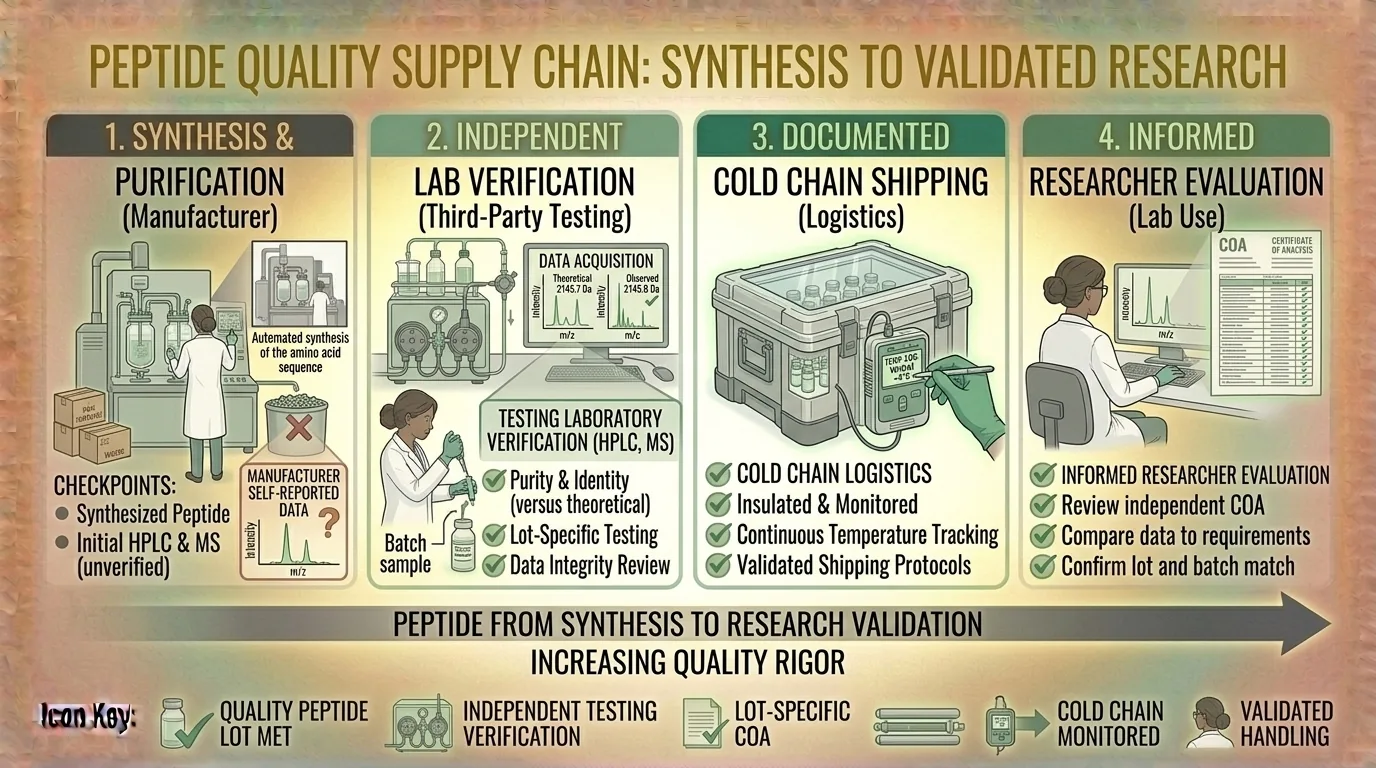
| Third-party HPLC testing | Independent purity verification | Common among reputable suppliers |
| Mass spectrometry | Molecular identity confirmation | Standard for quality suppliers |
| Lot-specific COAs | Batch traceability and documentation | Expected by informed researchers |
| Cold-chain shipping | Compound stability during transit | Variable — indicates quality focus |
| Clear labeling (research only) | Legal compliance and responsible positioning | Required by responsible suppliers |
What Researchers Should Know
- Quality is self-regulated — No external body inspects or certifies research peptide suppliers. Verification is your responsibility.
- COAs are voluntary — Their presence indicates a quality commitment; their absence is a significant red flag.
- "Research use only" means exactly that — Products are not approved for human use, and suppliers who suggest otherwise are operating outside accepted practice.
- Price correlates loosely with quality — Extremely low prices often indicate quality shortcuts, but high prices don't guarantee quality. COAs and testing data are the reliable indicators.
- The market is evolving — Industry standards are gradually improving as researchers demand better documentation and suppliers compete on quality rather than price alone.
Key Takeaways
- Research peptides are chemical reagents, not drugs or supplements — they fall outside consumer product regulation
- No mandatory quality testing exists — all quality practices are voluntary
- Responsible suppliers voluntarily adopt third-party testing, lot-specific COAs, and cold-chain shipping
- Supplier evaluation is the researcher's responsibility in the absence of regulatory oversight
- Industry standards are improving as demand for quality documentation increases
Research-Grade Quality
MHS Longevity maintains voluntary quality standards exceeding industry norms — third-party testing, lot-specific COAs, and cold-chain protocols for every compound.
Shop Peptides