
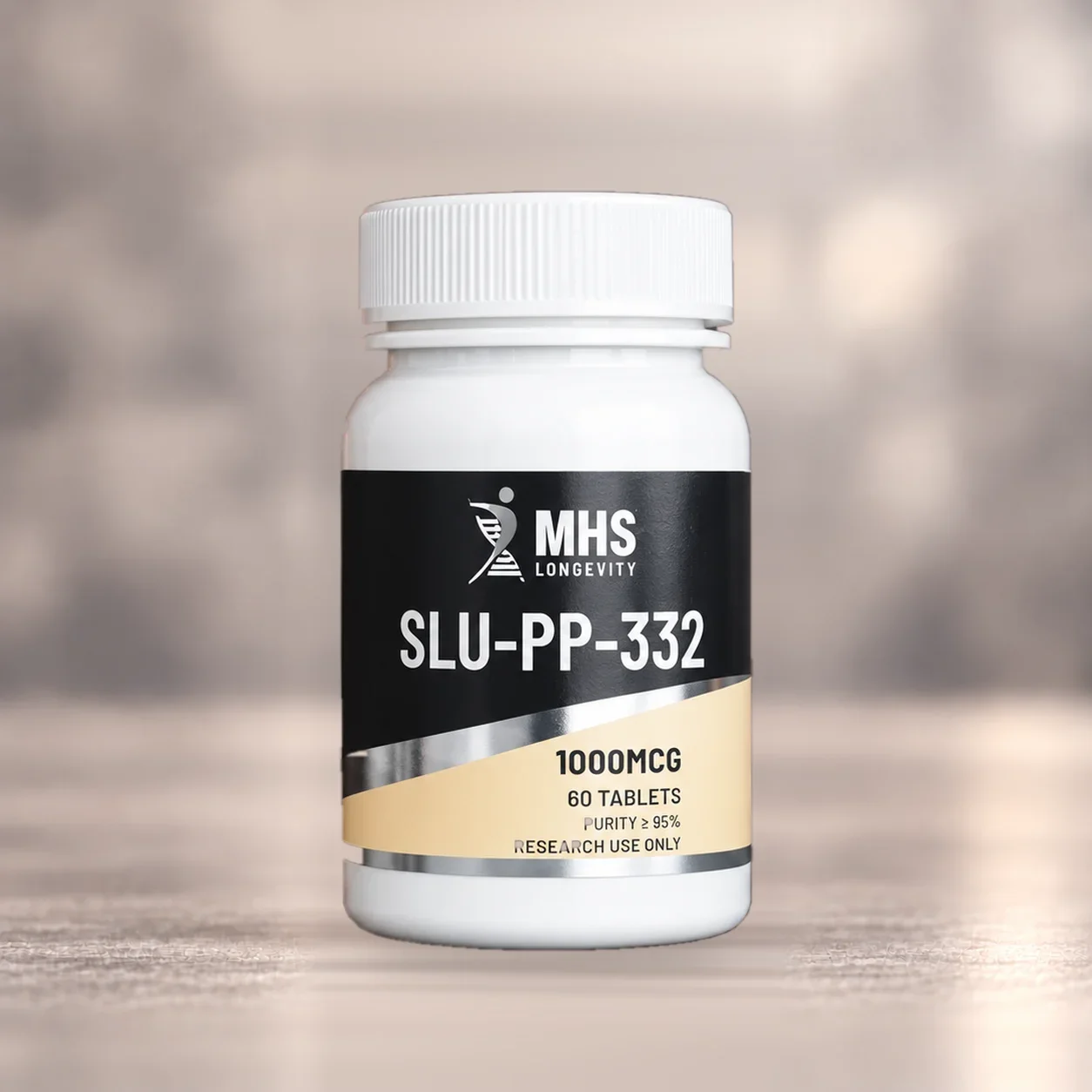
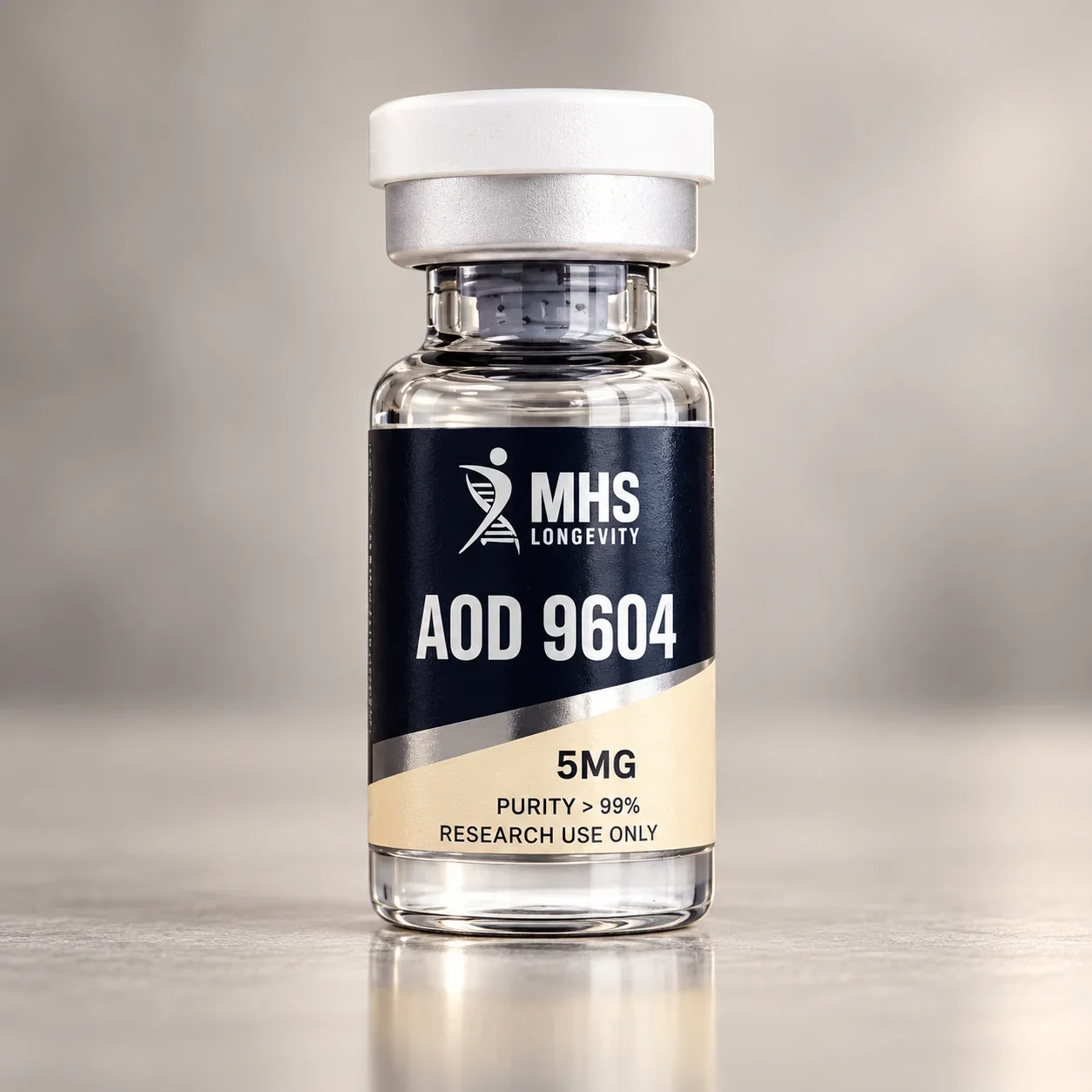
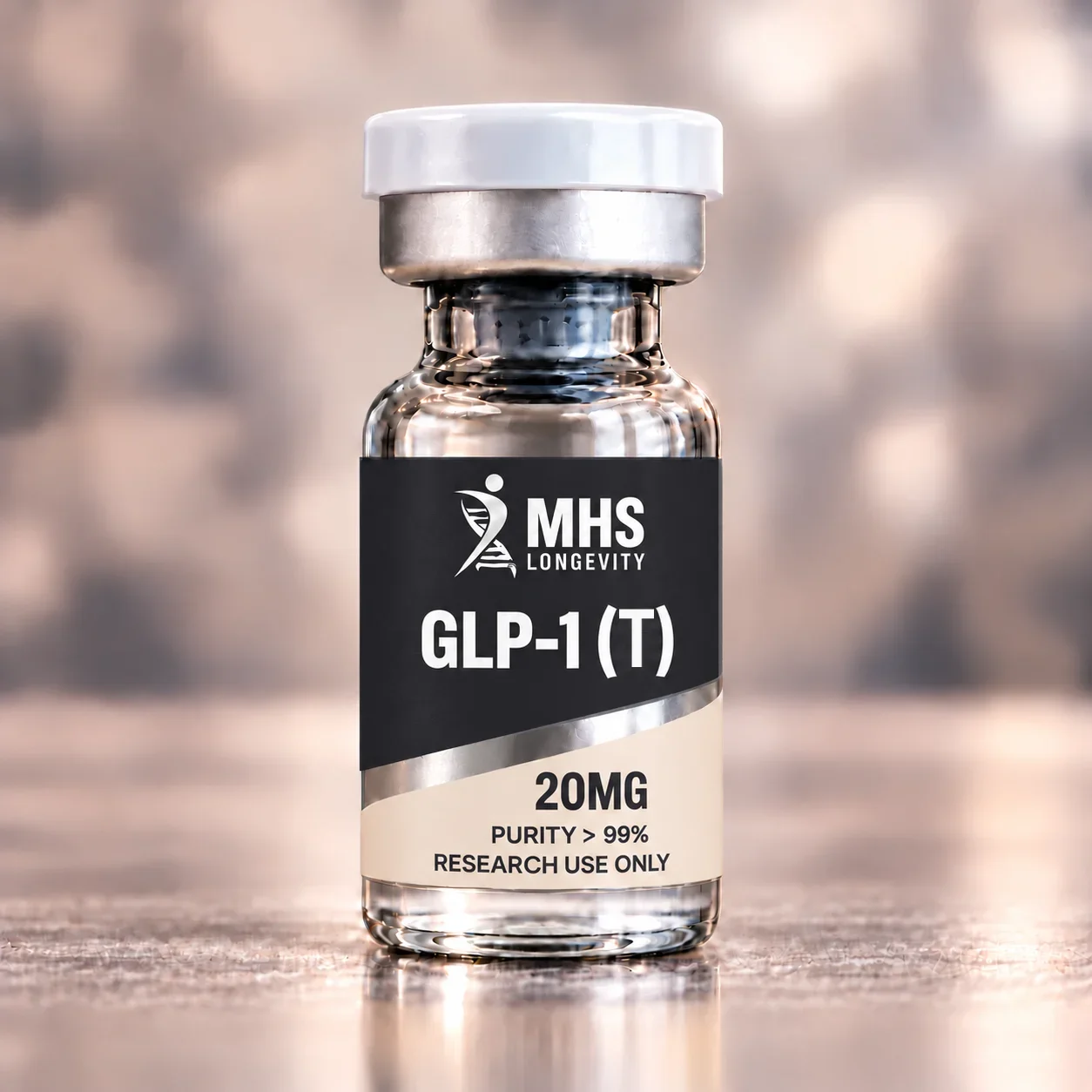
AOD 9604 5mg
A fat-specific growth hormone fragment researched for targeting adipose tissue signaling without broad systemic growth-hormone effects.
- 99%+ purity verified by independent HPLC + Mass Spec
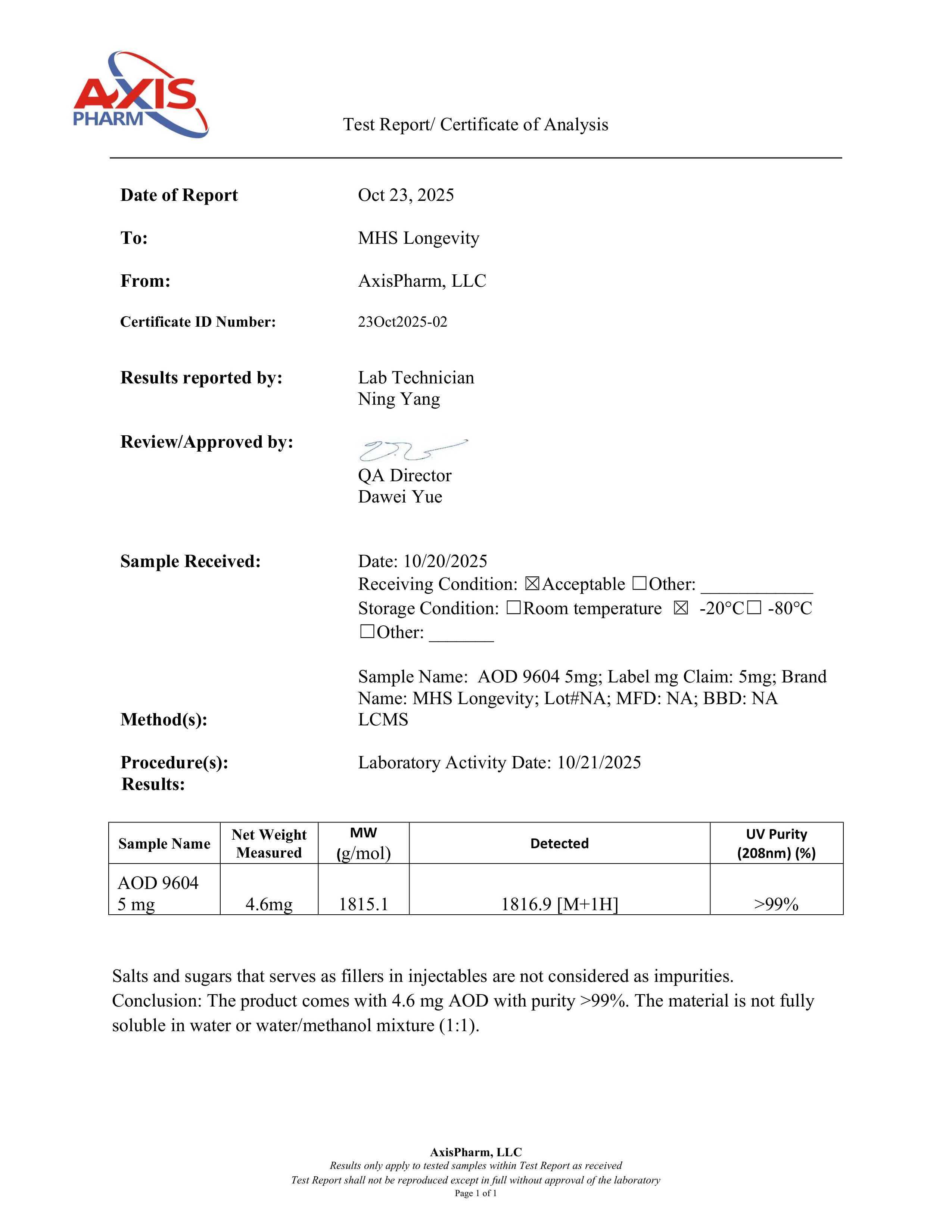
- Certificate of Analysis published — match it to your vial
- Ships from US facility · Free shipping over $150
$49.99
In stock — ships within 24h
For laboratory research use only. Not for human consumption.
Batch verification✓ Verified
- Purity (HPLC)
- >99%
- Method
- HPLC + MS
Storage & handling+
Lyophilized AOD-9604 should be stored at -20°C or below for extended stability. Once reconstituted in bacteriostatic water, the solution is typically held at 2–8°C and used within the documented stability window. Disulfide-containing peptides are sensitive to reducing agents and to extreme pH — exposure to either can break the disulfide bridge and produce a structurally different molecule. Standard aseptic technique applies during reconstitution, and contact with reducing-agent contaminants (DTT, beta-mercaptoethanol residue on glassware) should be avoided. For laboratory research use only.
Shipping & delivery+
Orders placed before 2pm ET ship the same business day from our US facility. Standard (2–4 days) or expedited options available. Free standard US shipping on orders over $150. Plain, unbranded packaging. Full shipping policy
Returns & damage policy+
Damaged or non-conforming orders are reshipped at no cost — contact support with a photo within 7 days of delivery. See our full returns policy for details. Full returns policy
We accept


Used in Weight Loss Protocol.
HPLC tested
99%+ purity verified
Public COAs
Third-party certificates
Veteran-owned
US-based fulfillment
Free shipping
On orders over $150
Overview
Description
A fat-specific growth hormone fragment researched for targeting adipose tissue signaling without broad systemic growth-hormone effects. Often chosen for cosmetic fat reduction and refined body-shaping goals.
AOD-9604 is commonly explored in research for supporting lipolysis-related pathways while maintaining a lean, athletic look— making it a popular add-on for body-composition refinement.
Scientific Overview
AOD-9604 is a synthetic peptide fragment derived from the C-terminal region of human growth hormone (amino acids 177–191). It has been studied for promoting lipolysis and inhibiting lipogenesis pathways in experimental models, with research interest focused on adipose tissue biology and body-composition signaling.
Product Details
- Compound: AOD-9604 (hGH fragment 177–191)
- Vial Size: 5mg
- Purity: ≥99%
- Form: Lyophilized powder
This product is intended strictly for laboratory research purposes only. It is not approved for human or veterinary use by the FDA or any other regulatory agency. Store in a cool, dry environment prior to reconstitution and handle using appropriate laboratory and aseptic techniques.
Frequently asked questions
Yes. Every batch of AOD 9604 5mg undergoes independent third-party testing using High-Performance Liquid Chromatography (HPLC) and Mass Spectrometry (MS). The Certificate of Analysis is published and accessible from the product page.
AOD 9604 5mg sold by MHS Longevity is verified to 99%+ purity, with the result documented in each batch's Certificate of Analysis. Anything below that threshold is rejected before release.
The Certificate of Analysis for AOD 9604 5mg is available directly from the product page and on our Third-Party Test Results page. Each COA includes the batch identifier, test date, testing method, and verified purity percentage.
AOD 9604 5mg ships from our US-based facility with standard or expedited options. Orders over $150 qualify for free standard US shipping. All orders are packaged discreetly with documented handling protocols.
No. AOD 9604 5mg is supplied strictly for laboratory research purposes only. It is not approved by the FDA for human or veterinary use, and it is not intended to diagnose, treat, cure, or prevent any disease.
MHS Longevity is a veteran-owned operation focused on pharmaceutical-grade research compounds. We source from vetted manufacturers, batch-test independently with HPLC and Mass Spectrometry, and publish every Certificate of Analysis. Pricing is transparent and the testing process is documented end-to-end.
AOD-9604 has a molecular weight of approximately 1817 g/mol in its oxidized (disulfide-bonded) form. The reduced form is 2 Da heavier (due to the two thiol hydrogens). This is documented on each batch's Certificate of Analysis alongside the Mass Spectrometry result confirming the disulfide.
AOD-9604 is a 16-amino-acid fragment of hGH (residues 177–191 with an N-terminal Tyr added), whereas full hGH is a 191-amino-acid protein. The Monash research program selected this specific fragment because animal-model studies reported it retained the lipolytic activity of full hGH without the growth-promoting effects mediated through the hGH receptor and IGF-1 axis. The two molecules have substantially different pharmacological profiles in the published research.
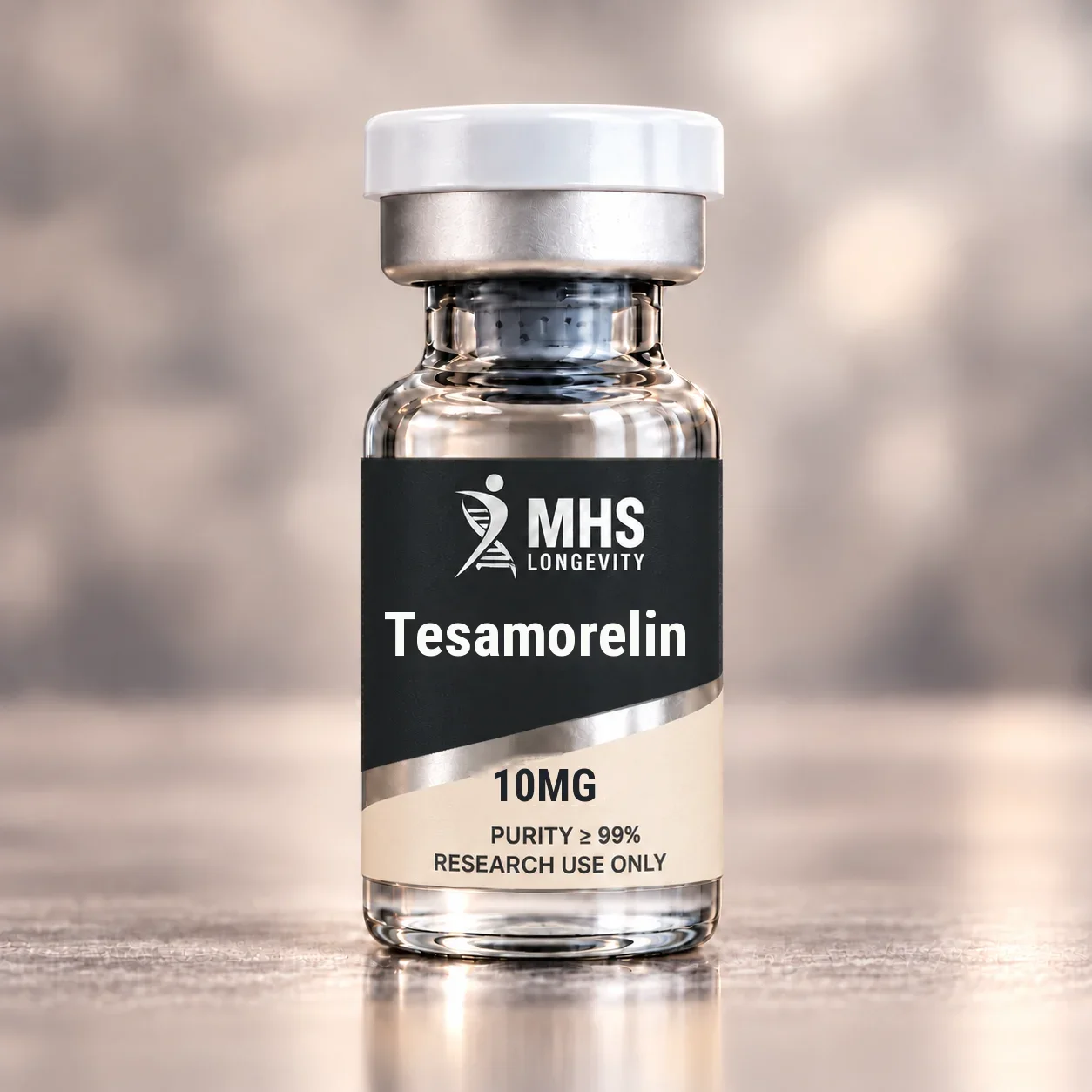
Tesamorelin is a stabilized analogue of growth-hormone-releasing hormone (GHRH) — it acts on the GHRH receptor upstream of hGH release. AOD-9604 is a fragment of hGH itself and is reported to act on a different pathway (likely a beta-3 adrenergic-like receptor in adipocytes) independent of the canonical hGH receptor. Both are research peptides that touch the growth-hormone axis, but they act at entirely different points.
AOD-9604 is sent to an independent third-party laboratory for HPLC and Mass Spectrometry analysis before each batch is released. The lab's identifier and test date are published on the Certificate of Analysis for that batch, including explicit confirmation that the Cys7–Cys14 disulfide bond is intact.
You may also like
Research & buying
The evidence behind AOD 9604 5mg and the questions to ask any vendor before you order.
Research details — AOD 9604 5mg
AOD-9604 is a synthetic 16-amino-acid peptide corresponding to a fragment of the C-terminus of human growth hormone (hGH), with a tyrosine residue added at the N-terminus. The molecule originated from research at Monash University in the 1990s investigating which parts of the hGH sequence drive its lipolytic effects independently of the insulin-resistance and IGF-1-elevating effects that the full hormone produces. The acronym 'AOD' stood for Anti-Obesity Drug in the original research program. This guide explains what AOD-9604 is, the published research context, and how its quality is independently verified.
What is AOD-9604?
AOD-9604 has the sequence Tyr-Leu-Arg-Ile-Val-Gln-Cys-Arg-Ser-Val-Glu-Gly-Ser-Cys-Gly-Phe — 16 amino acids total. The two cysteine residues (positions 7 and 14) form an intramolecular disulfide bond that constrains the molecule into a small loop, mirroring the corresponding region of native human growth hormone (residues 177–191) with an N-terminal Tyr added for synthesis and labeling reasons. The molecular weight is approximately 1817 g/mol. It is supplied as a lyophilized white powder for laboratory reconstitution.
AOD-9604 is sold strictly for laboratory and research use. It is not approved by the FDA or any other regulatory body for human or veterinary use, and nothing in this guide constitutes guidance for human administration.
Research context
The Monash research program that produced AOD-9604 was specifically asking: can the lipolytic activity of growth hormone be uncoupled from its growth-promoting and metabolic side effects? Published animal-model work reported that AOD-9604 produced fat-loss endpoints in obese rodent models without elevating IGF-1, without inducing insulin resistance, and without the cell-proliferation signaling normally associated with the full hGH receptor. The proposed mechanism centers on activation of a beta-3 adrenergic-like pathway in adipocytes rather than via the canonical hGH receptor. The molecule entered human clinical trials in the early 2000s; researchers should evaluate the primary clinical and preclinical literature directly.
How AOD-9604 quality is verified
AOD-9604's quality verification is more demanding than for a typical linear 16-mer because the intramolecular disulfide bond must be formed in the correct topology. An incorrectly oxidized or reduced sample will have the same amino-acid content but different three-dimensional structure and different biological activity. Every batch of MHS Longevity AOD-9604 is submitted to an independent third-party laboratory before release:
- HPLC separates components by chemistry and measures the AOD-9604 peak as a percentage of total peak area. Reduced (open-disulfide) and oxidized (closed-disulfide) forms elute at distinguishable retention times — the chromatogram shows whether the disulfide is in place. Anything below 99% is rejected.
- Mass Spectrometry confirms the disulfide-bonded form via the mass shift relative to the reduced form (-2 Da per disulfide). For AOD-9604 this is a clean MS readout that confirms the disulfide bridge between Cys7 and Cys14 is intact.
What an AOD-9604 Certificate of Analysis shows
- Compound name and structural designation. AOD-9604, with full 16-residue sequence and notation that the Cys7–Cys14 disulfide bond is documented.
- Batch identifier. Unique ID linking certificate to vial.
- Test date. When the analysis was performed.
- Method. HPLC, MS, or both, with column and mobile-phase notes.
- Verified purity %. The HPLC result. We require 99%+.
- Disulfide bond confirmation. Mass spectrometry mass shift confirms the oxidized (disulfide-bonded) state.
- Lab and signatures. The independent lab performing the analysis.
Storage and handling (research lab context)
Lyophilized AOD-9604 should be stored at -20°C or below for extended stability. Once reconstituted in bacteriostatic water, the solution is typically held at 2–8°C and used within the documented stability window. Disulfide-containing peptides are sensitive to reducing agents and to extreme pH — exposure to either can break the disulfide bridge and produce a structurally different molecule. Standard aseptic technique applies during reconstitution, and contact with reducing-agent contaminants (DTT, beta-mercaptoethanol residue on glassware) should be avoided.
Where to buy AOD 9604 5mg
The same eight questions apply whether you're buying AOD 9604 5mg from us or anywhere else. Vendors who can't answer any of them are worth a closer look.
Vendor evaluation checklist
1. Is the Certificate of Analysis public and downloadable?
A vendor unwilling to publish HPLC/MS results for the batch you're buying has nothing to verify their purity claim against.
2. Which testing method was used — HPLC, Mass Spectrometry, or both?
HPLC measures purity. Mass Spectrometry confirms the molecule's identity. Reputable batches go through both.
3. What's the verified purity percentage on the published COA?
Industry research standard is 99%+. Below that, you're paying for a compound diluted with synthesis byproducts.
4. Where does the product ship from?
US-based fulfillment generally means shorter handling times, customs-free delivery, and clearer return remedies.
5. Is the price published at a single list rate, or hidden behind tier locks?
Opaque pricing is a yellow flag. Transparent vendors quote the same number to every customer.
6. What's the free-shipping threshold, if any?
Compare the all-in cost (product + shipping + handling) — not just the headline price.
7. How is the product stored prior to shipment?
Lyophilized peptides degrade with temperature swings. Vendors should disclose temperature-controlled storage.
8. Is there a documented damage-claim and return policy?
Discreet shipping carries handling risk. A clear, written policy protects you when something goes wrong.
MHS LongevityThis site - Price
- $49.99
- Purity
- 99%+
- Testing
- HPLC + MS
- COA public
- US-based
- Free shipping
- $150+
- Last checked
- Oct 10, 2026
| Vendor | Price | Listed purity | Testing method | COA public | US-based | Free shipping | Last checked |
|---|---|---|---|---|---|---|---|
MHS LongevityThis site | $49.99 | 99%+ | HPLC + MS | $150+ | Oct 10, 2026 |
Competitor data sourced from each vendor's public product page on the date shown. Listed purity reflects each vendor's own published claim; Certificate of Analysis availability is verified at the URL above. Data may have changed since last check.