

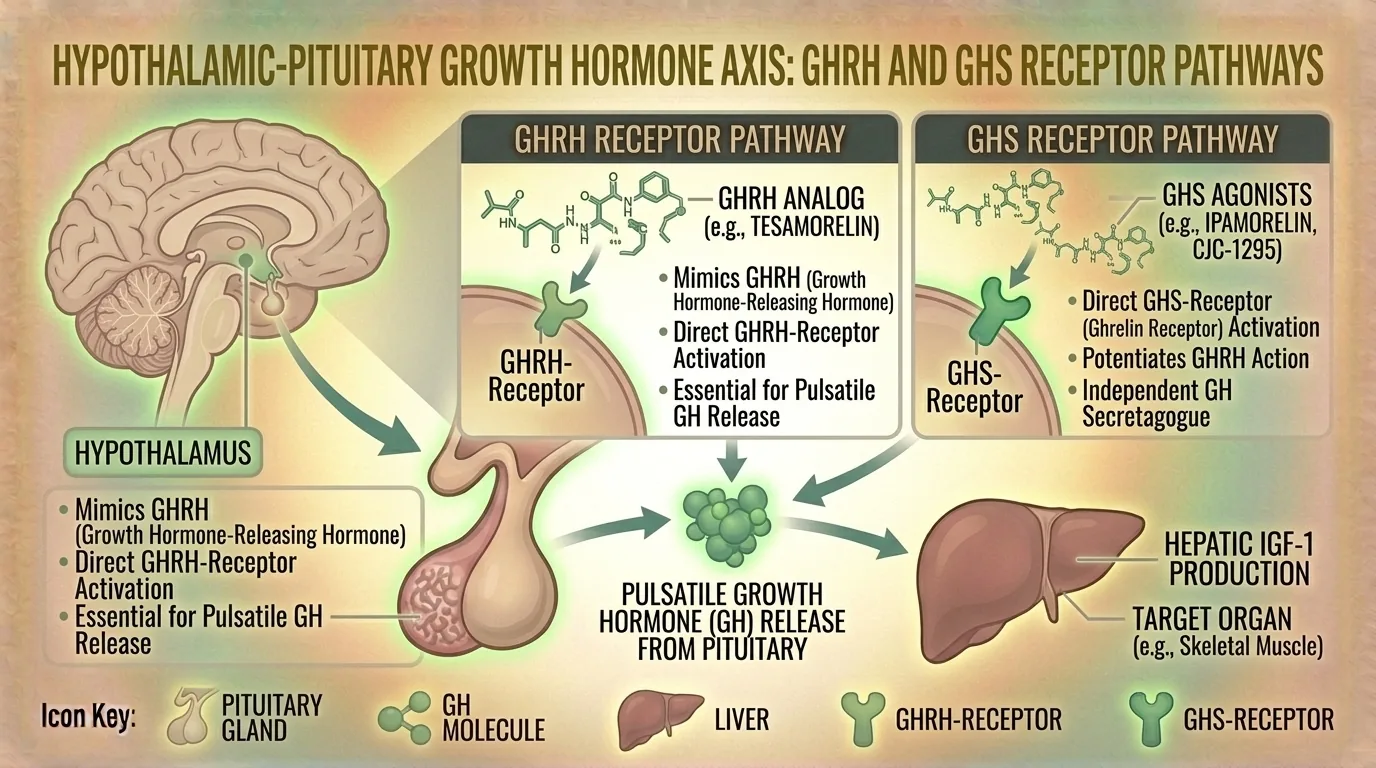
Growth hormone secretagogues (GHS) are compounds that stimulate the pituitary gland to release growth hormone (GH) through activation of specific receptor pathways. Unlike exogenous GH administration, secretagogues promote the body's own pulsatile GH secretion patterns — a distinction with significant implications for research design.
Two Receptor Pathways
GH secretion is regulated by two primary pathways, and secretagogues target one or both:
| Pathway | Receptor | Effect | Example Compounds |
|---|---|---|---|
| GHRH pathway | GHRH receptor | Stimulates GH synthesis and release | CJC-1295, Tesamorelin, Sermorelin |
| Ghrelin/GHS pathway | GHS-R (ghrelin receptor) | Amplifies GH pulse amplitude | Ipamorelin, MK-677, GHRP-6 |
Key Research Compounds
Ipamorelin
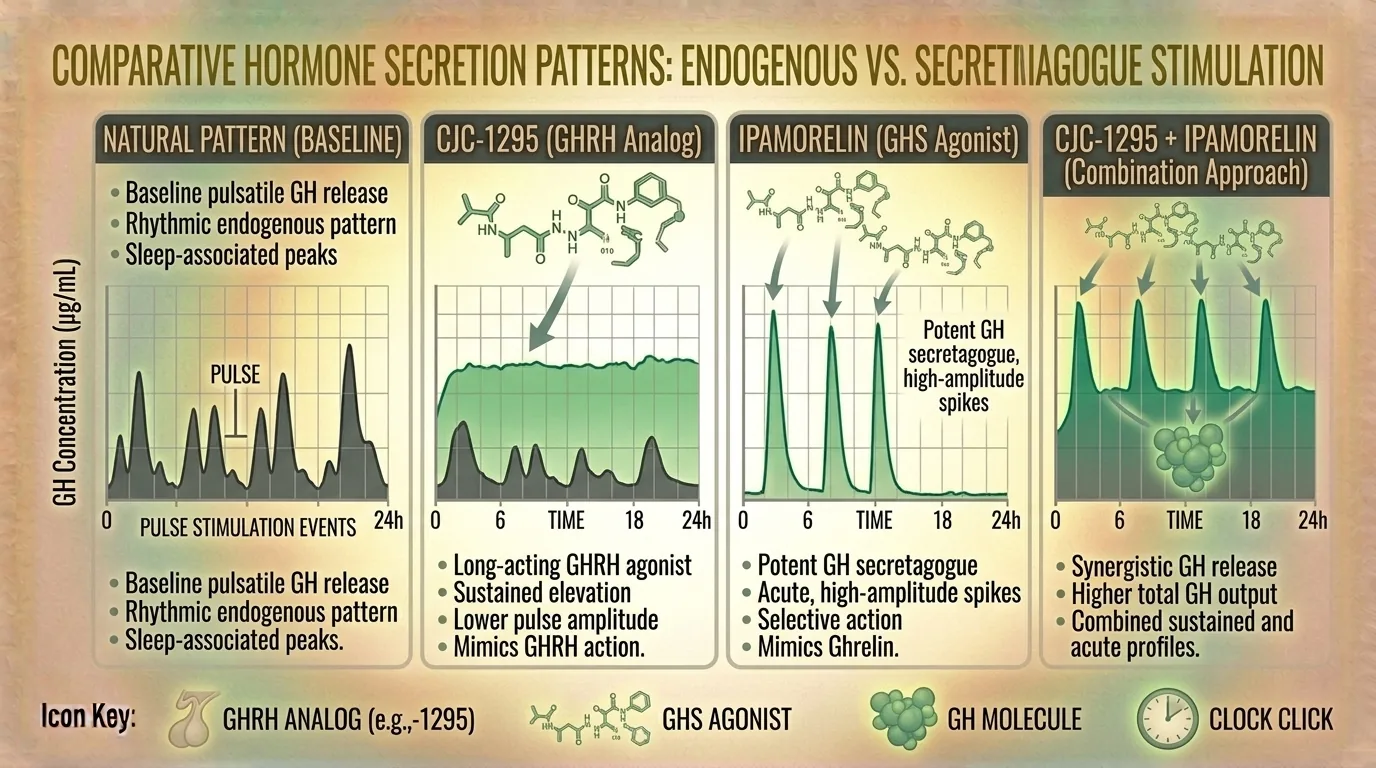
Ipamorelin is a selective GHS-receptor agonist. Research indicates it stimulates GH release without significantly affecting cortisol, prolactin, or ACTH levels — making it one of the most selective GH secretagogues studied.
CJC-1295
CJC-1295 is a GHRH analog with an extended half-life (days vs. minutes for native GHRH). It sustains elevated GH secretion over longer periods. The DAC (Drug Affinity Complex) variant further extends half-life through albumin binding.
Tesamorelin
Tesamorelin is a GHRH analog that has been studied in clinical settings for visceral fat reduction. It stimulates physiological GH secretion patterns and has been the subject of multiple controlled human trials.
Key Takeaways
- GH secretagogues stimulate endogenous GH release rather than providing exogenous hormone
- Two receptor pathways exist: GHRH receptor and GHS receptor (ghrelin receptor)
- Ipamorelin is notable for selective GH stimulation without cortisol/prolactin elevation
- CJC-1295 provides extended GHRH signaling; Tesamorelin has controlled human trial data
- Combination protocols targeting both pathways are an active research area
Growth & Recovery Peptides
Explore verified research-grade secretagogues and recovery compounds.
Shop Peptides