
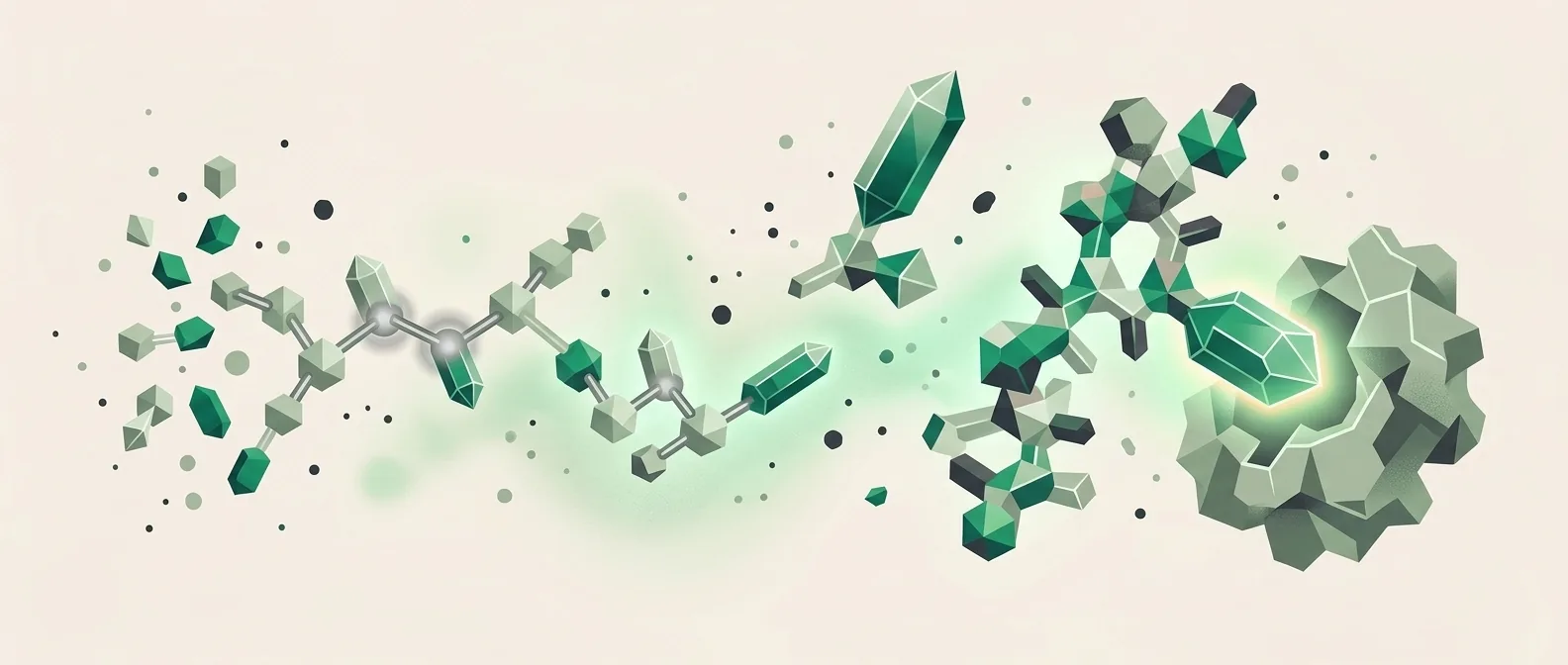
Peptides are biologically active molecules composed of short chains of amino acids — typically between 2 and 50 residues linked by peptide bonds. Unlike larger proteins that fold into complex three-dimensional structures, peptides are small enough to interact directly with cell-surface receptors and intracellular targets, making them valuable tools for targeted biological research.
This primer covers the fundamentals: what peptides are, how they're synthesized, and how they interact with biological systems at the molecular level.
Amino Acids: The Building Blocks
All peptides are built from the same set of 20 standard amino acids. Each amino acid has a unique side chain (R-group) that determines its chemical properties — charge, hydrophobicity, size, and reactivity. The specific sequence of amino acids in a peptide determines its shape, receptor affinity, and biological activity.
How Peptide Bonds Form
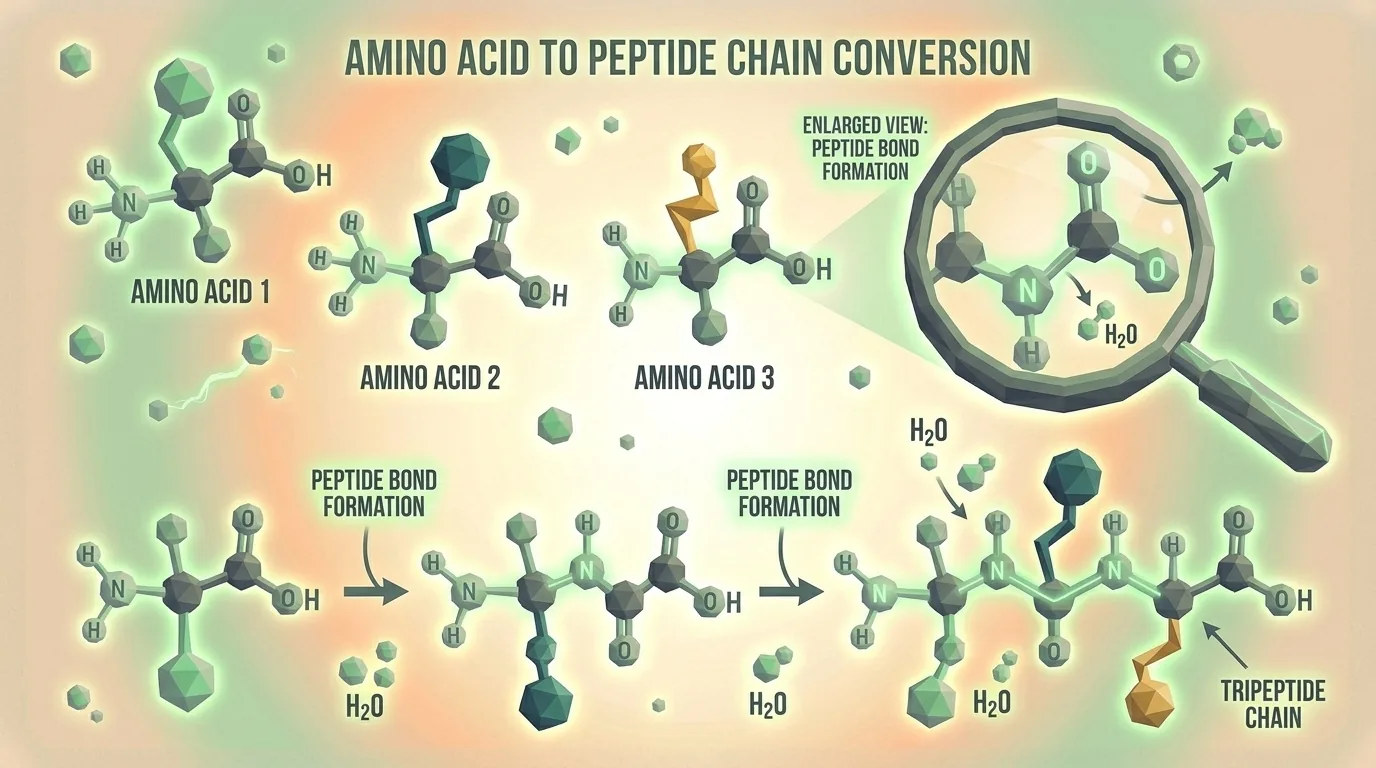
A peptide bond is a covalent bond formed through a condensation reaction between two amino acids. The carboxyl group (-COOH) of one amino acid reacts with the amino group (-NH₂) of the next, releasing a molecule of water and forming a C-N bond. This process repeats sequentially to build the full peptide chain.
The resulting backbone is rigid and planar at each peptide bond, while the side chains project outward — creating the unique molecular surface that determines how the peptide interacts with its target.
Solid-Phase Peptide Synthesis (SPPS)
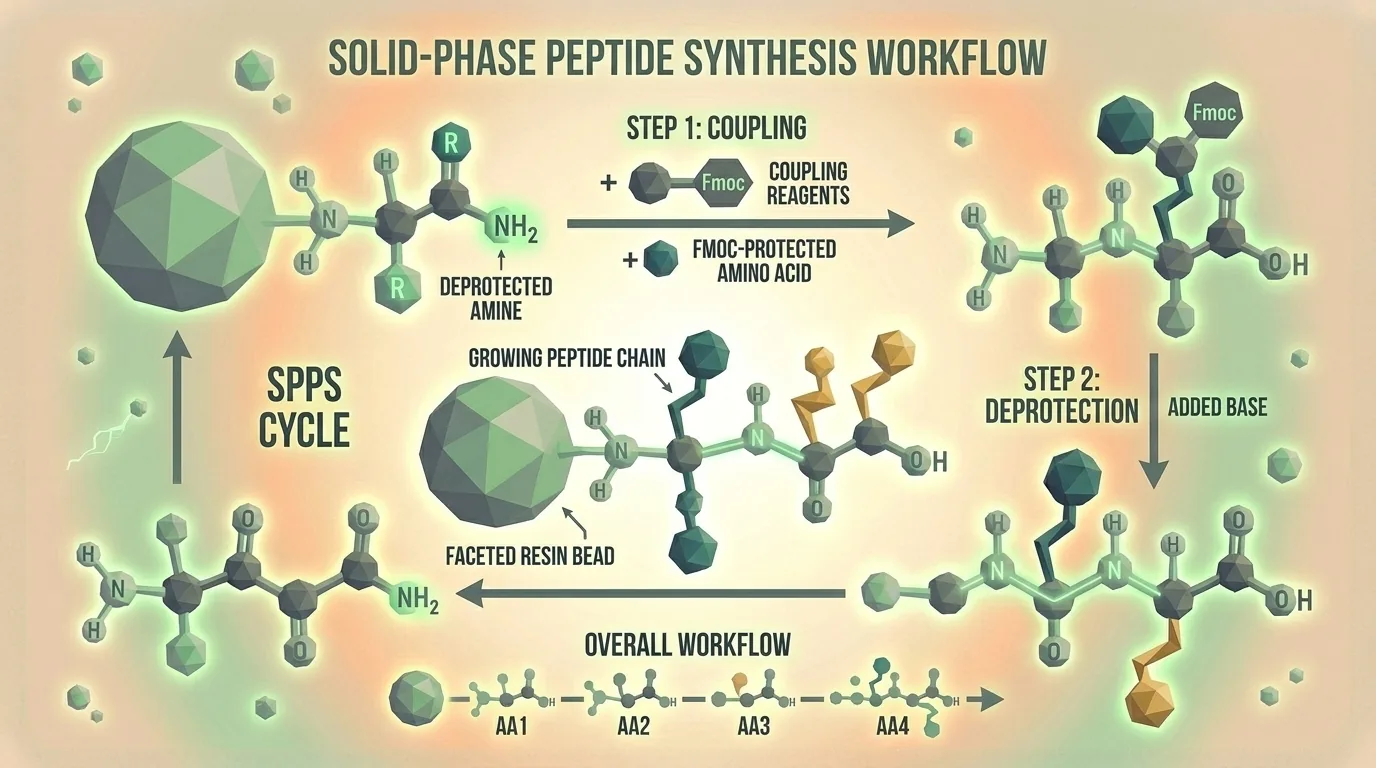
Most research peptides are manufactured using Solid-Phase Peptide Synthesis, a method developed by Robert Bruce Merrifield in 1963. The process anchors the first amino acid to an insoluble resin bead, then adds subsequent residues one at a time in a controlled sequence.
- Anchoring — The C-terminal amino acid is attached to the solid resin support
- Deprotection — The protecting group on the amino terminus is removed, exposing the reactive amine
- Coupling — The next amino acid (with its own protecting group) is activated and coupled to the growing chain
- Repeat — Steps 2-3 repeat for each amino acid in the sequence
- Cleavage — The completed peptide is chemically cleaved from the resin
- Purification — HPLC removes incomplete sequences and side products
Receptor Interactions: How Peptides Signal
Peptides exert biological effects primarily by binding to specific receptors on cell surfaces. This binding is highly selective — the peptide's amino acid sequence creates a unique molecular shape that fits into the receptor's binding pocket like a key in a lock.
When a peptide binds its target receptor, it triggers a conformational change that initiates an intracellular signaling cascade. This cascade can activate enzymes, open ion channels, or alter gene expression — producing the peptide's observed biological effects.
Peptide Categories in Research
| Category | Examples | Research Focus |
|---|---|---|
| Growth hormone peptides | CJC-1295, Ipamorelin, Tesamorelin | Growth hormone secretion, body composition |
| Regenerative peptides | BPC-157, TB-500 | Tissue repair, wound healing pathways |
| Metabolic peptides | AOD 9604, 5-Amino 1MQ | Fat metabolism, energy regulation |
| Neuropeptides | Selank, Semax, Dihexa | Cognitive function, neuroplasticity |
| Immune peptides | Thymosin Alpha-1, LL-37 | Immune modulation, antimicrobial activity |
Bioavailability and Delivery
One of the primary challenges in peptide research is delivery. Peptides are generally not orally bioavailable — digestive enzymes (proteases) break them down before they can be absorbed. Most research peptides are therefore administered via subcutaneous injection, which bypasses the gastrointestinal tract and delivers the compound directly into systemic circulation.
The gastrointestinal tract contains multiple classes of proteolytic enzymes (pepsin, trypsin, chymotrypsin) that systematically break peptide bonds. Additionally, the intestinal epithelium presents a barrier to absorption of molecules above ~500 daltons. Most research peptides are 1,000–5,000+ daltons, making oral delivery impractical without specialized formulation strategies.
Some research is exploring modifications like cyclization, D-amino acid substitution, and nanoparticle encapsulation to improve oral bioavailability, but these remain areas of active investigation.
Key Takeaways
- Peptides are short amino acid chains (2–50 residues) that interact with specific biological receptors
- Solid-Phase Peptide Synthesis (SPPS) enables precise manufacturing of defined sequences
- Biological activity depends on the peptide's unique amino acid sequence and resulting molecular shape
- Peptide-receptor binding triggers intracellular signaling cascades that produce specific biological effects
- Most research peptides require subcutaneous administration due to limited oral bioavailability
Frequently Asked Questions
An amino acid is a single molecular building block. A peptide is a chain of two or more amino acids linked by peptide bonds. The biological activity of a peptide emerges from the specific sequence and interactions of its constituent amino acids.
Modern SPPS can synthesize a typical research peptide (10–40 amino acids) in 1–3 days. Purification and quality verification (HPLC, mass spectrometry) add additional time. The total manufacturing cycle is typically 1–2 weeks.
No. Synthesis quality depends on the manufacturer's equipment, reagent purity, coupling efficiency, and purification methods. This is why third-party testing and Certificates of Analysis are essential for verifying that a peptide meets its stated purity specifications.
Explore Research-Grade Peptides
Every MHS Longevity compound is synthesized to 99%+ purity and verified through independent third-party analysis.
Shop Peptides