

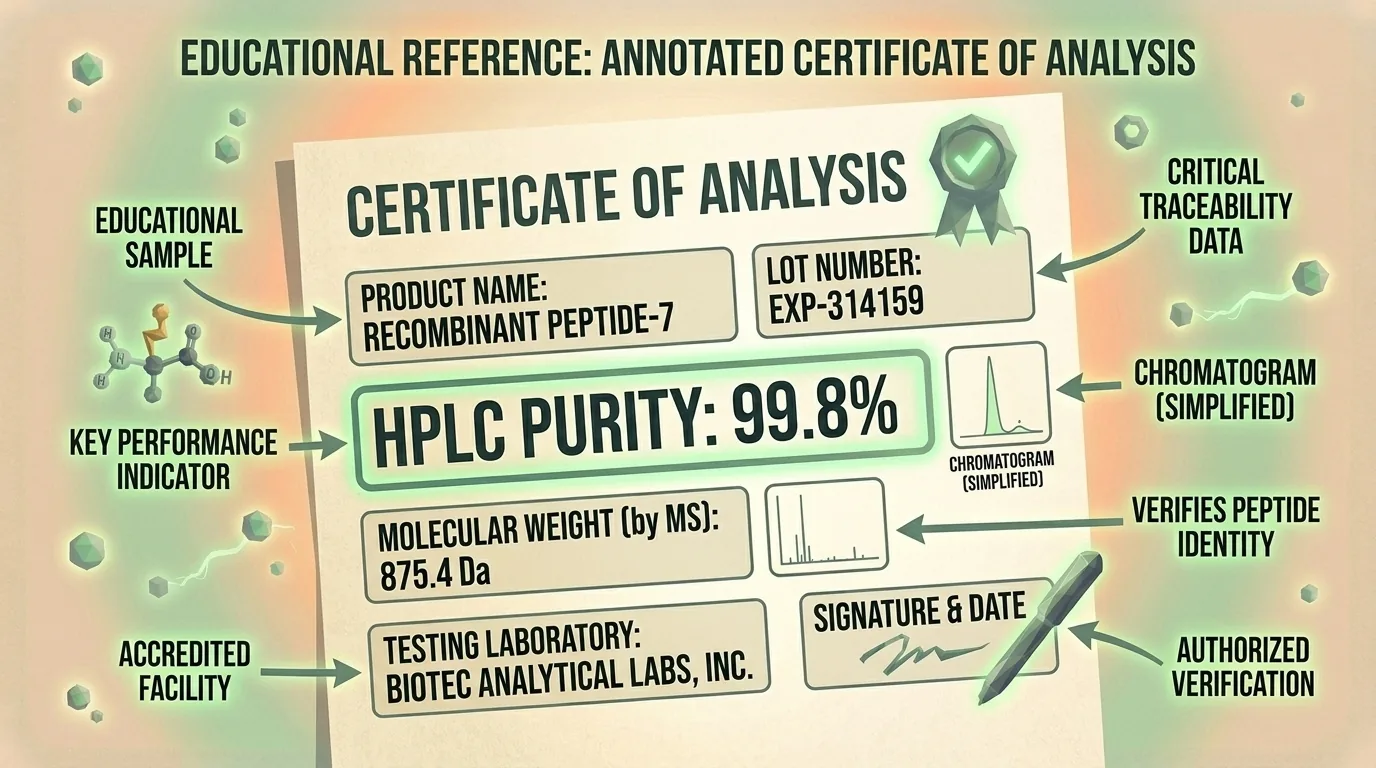
A Certificate of Analysis (COA) is the single most important document for evaluating peptide quality. It provides an objective record of a compound's identity, purity, and physical characteristics — generated by analytical testing of a specific manufacturing lot.
Yet many researchers encounter COAs without fully understanding what each field represents or how to distinguish a thorough report from one that omits critical information. This guide walks through every section of a standard peptide COA.
What a COA Tells You
At its core, a COA answers three questions about a specific lot of peptide: Is this the right compound? (identity), How pure is it? (purity), and What does the physical sample look like? (appearance). Each question is answered by specific analytical methods.
Field-by-Field Breakdown
Product Identification
The top of the COA identifies the compound: product name, catalog or reference number, molecular formula, and theoretical molecular weight. This establishes what the peptide should be before the analytical data confirms what it actually is.
Lot / Batch Number
Every COA must reference a specific lot number. This is the unique identifier for the manufacturing run that produced your sample. A COA without a lot number — or one that uses the same number across different production dates — is a significant red flag.
Mass Spectrometry Results
Mass spectrometry (MS) confirms the molecular identity of the compound. The report shows the observed molecular weight compared to the theoretical weight. A match (typically within ±1 dalton) confirms the correct amino acid sequence was synthesized.
HPLC Purity
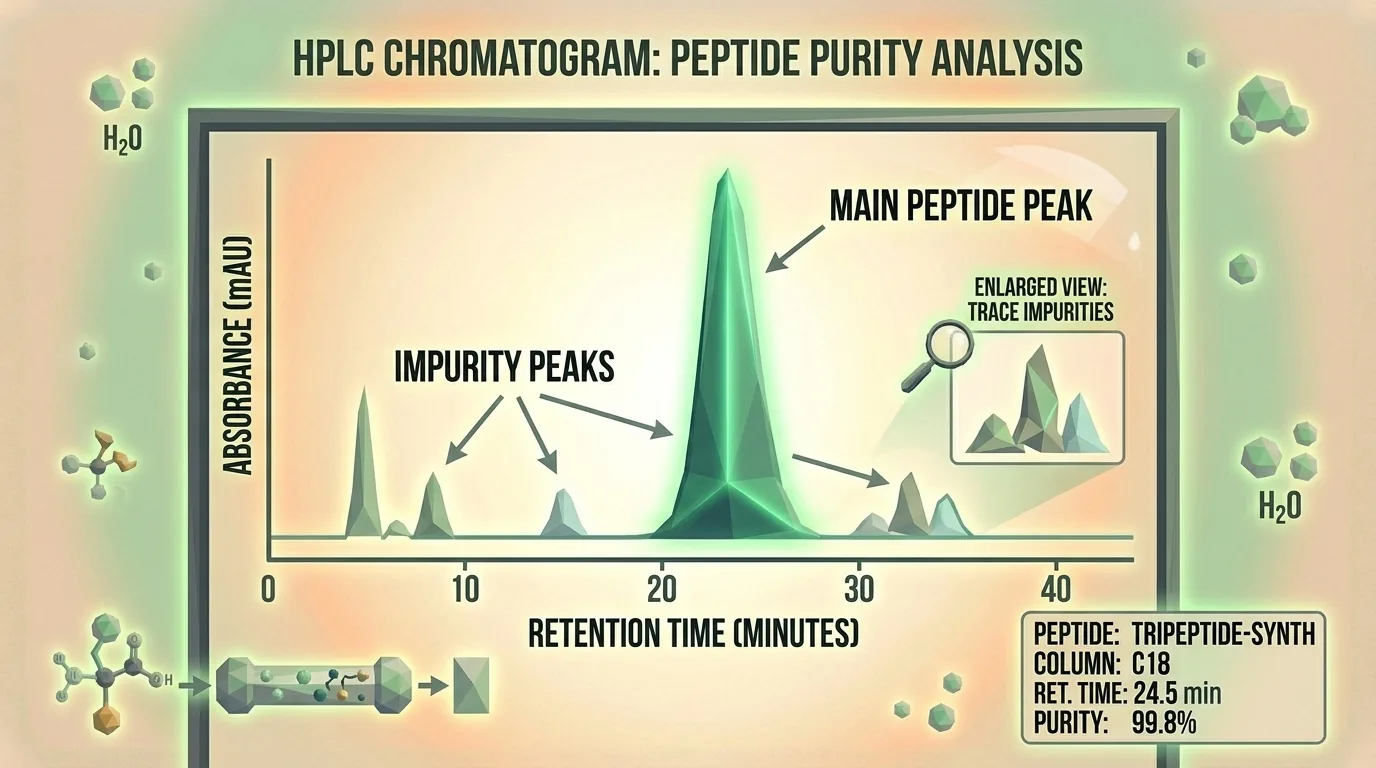
The HPLC purity percentage is the most scrutinized number on a COA. It represents the proportion of the target peptide in the sample relative to all other components (impurities, degradation products, synthesis byproducts). Research-grade peptides typically show 98%+ purity.
Physical Appearance
The COA documents the physical form of the sample — typically "white to off-white lyophilized powder" for peptides. Deviations (discoloration, visible moisture, non-uniform texture) may indicate degradation or contamination.
Testing Laboratory and Date
A credible COA identifies who performed the testing and when. Third-party laboratory identification (name, accreditation) adds independent verification. The testing date should be reasonably close to the product's availability date.
Red Flags in COA Documents
- No lot number — The COA isn't tied to a specific production run
- Suspiciously round numbers — Purity listed as exactly 99.00% on every lot suggests fabrication
- No laboratory identification — Impossible to verify the testing was actually performed
- UV-only testing — Insufficient for peptide purity; HPLC and MS are the standard
- Generic COA — Same document reused across different lots or products
- No testing date — Impossible to assess the relevance of the data
How to Verify a COA
- Confirm the lot number on the COA matches your product's lot number
- Verify the testing laboratory exists independently (search their name)
- Check that HPLC and mass spectrometry methods are listed (not just UV)
- Compare the observed molecular weight against the known theoretical weight
- Contact the testing lab directly if you have questions about authenticity
Key Takeaways
- A COA answers three questions: identity (MS), purity (HPLC), and physical characteristics
- Every COA must be lot-specific — generic or reused COAs are red flags
- HPLC purity of 98%+ is the standard for research-grade peptides
- Both identity confirmation (MS) and purity analysis (HPLC) are required for credible verification
- The testing laboratory should be named and independently verifiable
Frequently Asked Questions
Reputable suppliers either include a COA with every order or make them readily available on request. If a supplier cannot provide a lot-specific COA for your purchase, that is a significant quality concern.
For most research applications, 98%+ purity (as measured by HPLC) is the standard. Some specialized applications may require higher purity, while preliminary screening work may tolerate lower levels.
Verified Research Peptides
Every MHS Longevity product includes a lot-specific COA with HPLC and mass spectrometry verification.
Shop Peptides