

High-Performance Liquid Chromatography (HPLC) and mass spectrometry (MS) are the two foundational analytical methods for peptide quality verification. Together, they answer the two most critical questions about any research compound: How pure is it? and Is it the right molecule?
HPLC: Measuring Purity
How It Works
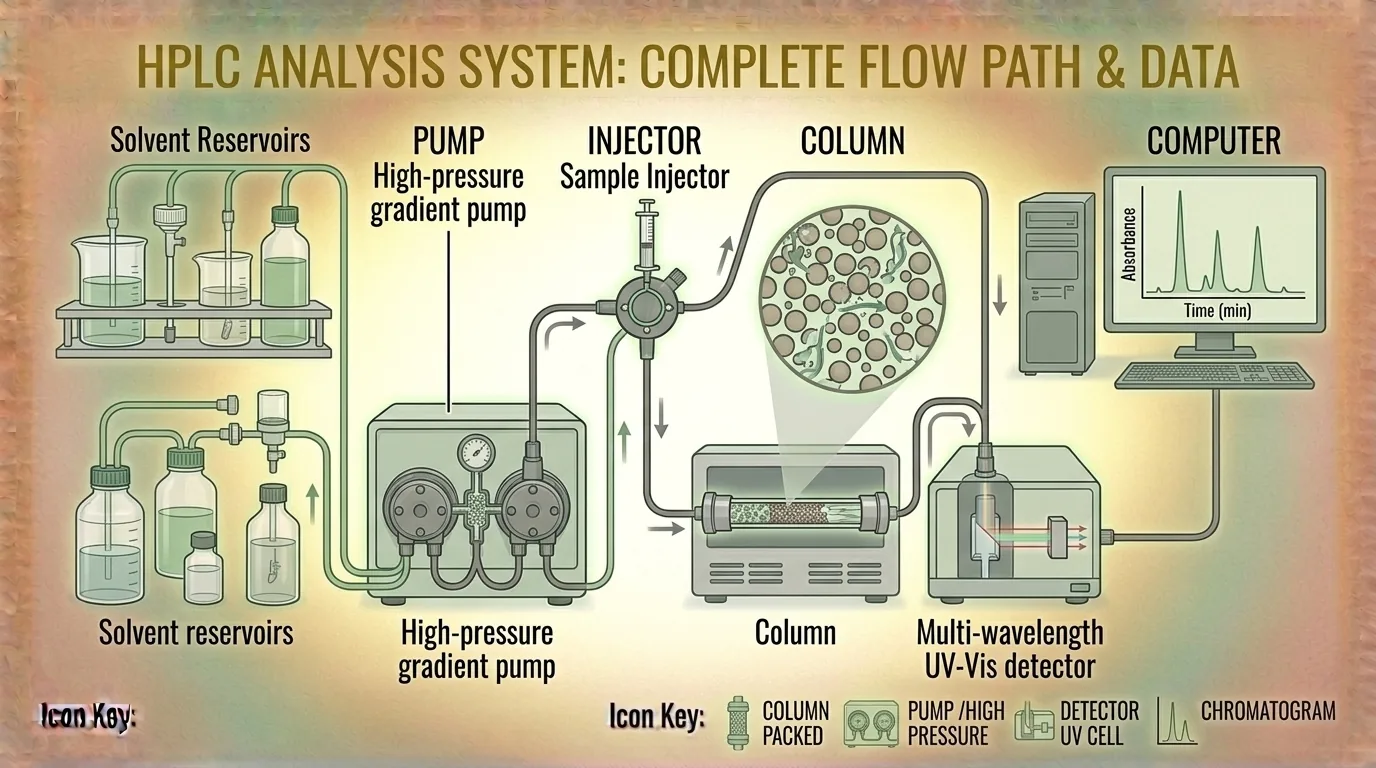
HPLC separates a liquid sample into its individual chemical components by passing it through a column packed with solid particles (the stationary phase) under high pressure. Different molecules interact with the column material differently, causing them to elute (exit) at different times. A detector at the column outlet measures each component as it emerges.
The result is a chromatogram — a graph showing detector response over time. Each peak represents a different component, and the area of the main peptide peak relative to all other peaks gives the purity percentage.
Key HPLC Parameters
| Parameter | What It Means | Why It Matters |
|---|---|---|
| Retention time | When the peptide elutes from the column | Identifies the target compound |
| Peak area % | Proportion of total signal from the main peak | The purity percentage |
| Resolution | Separation between adjacent peaks | Ensures impurities are resolved from the target |
| Column type | C18 reverse-phase is standard for peptides | Determines separation characteristics |
Mass Spectrometry: Confirming Identity
How It Works
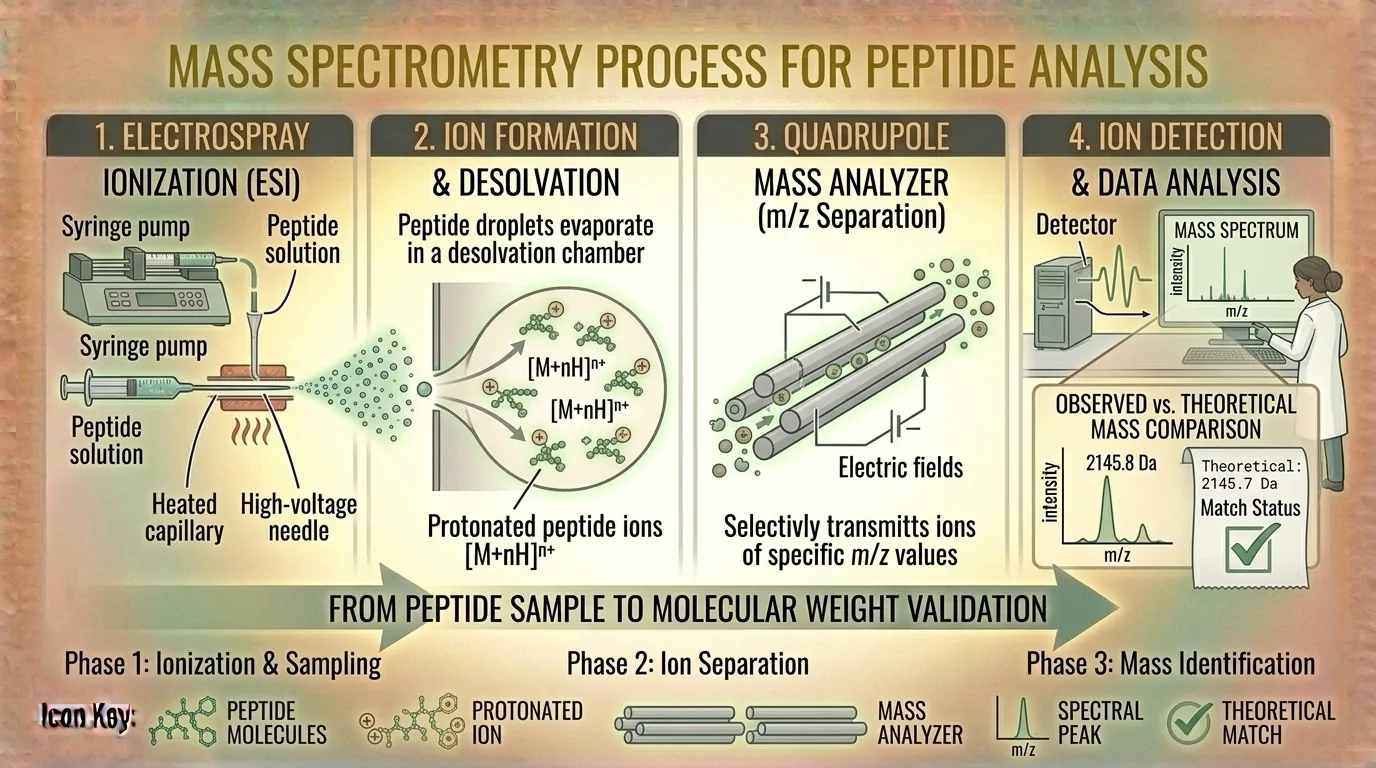
Mass spectrometry measures the mass-to-charge ratio (m/z) of ionized molecules. The sample is ionized (typically by electrospray ionization for peptides), and the resulting ions are separated by their m/z values in a mass analyzer. The output is a mass spectrum showing the molecular weight of the compound.
For peptide verification, the observed molecular weight is compared to the theoretical weight calculated from the amino acid sequence. A match confirms the correct compound was synthesized.
HPLC + MS: Why Both Are Needed
LC-MS: The Combined Approach
Liquid Chromatography-Mass Spectrometry (LC-MS) couples an HPLC system directly to a mass spectrometer. This allows simultaneous separation and identification — each peak in the chromatogram can be matched to a specific molecular weight. LC-MS is becoming the standard for comprehensive peptide quality analysis.
Key Takeaways
- HPLC measures purity by separating sample components and quantifying the target peptide peak
- Mass spectrometry confirms identity by measuring molecular weight against theoretical predictions
- Both methods are required for comprehensive quality verification — neither alone is sufficient
- LC-MS combines both techniques for simultaneous purity and identity analysis
- Standard peptide testing should include both HPLC purity data and MS identity confirmation
Independently Verified Peptides
Every MHS Longevity compound is tested by HPLC and mass spectrometry through accredited third-party laboratories.
Shop Peptides