
Even the highest-purity research peptide can degrade if stored or handled improperly. Temperature fluctuations, light exposure, moisture, and repeated freeze-thaw cycles all compromise compound integrity — potentially reducing effective purity well below the specifications documented on the Certificate of Analysis.
This guide covers the key storage and handling principles that help maintain alignment between documented specifications and actual compound condition throughout the product’s usable lifespan.
Lyophilized vs. Reconstituted: Two Different Storage Profiles
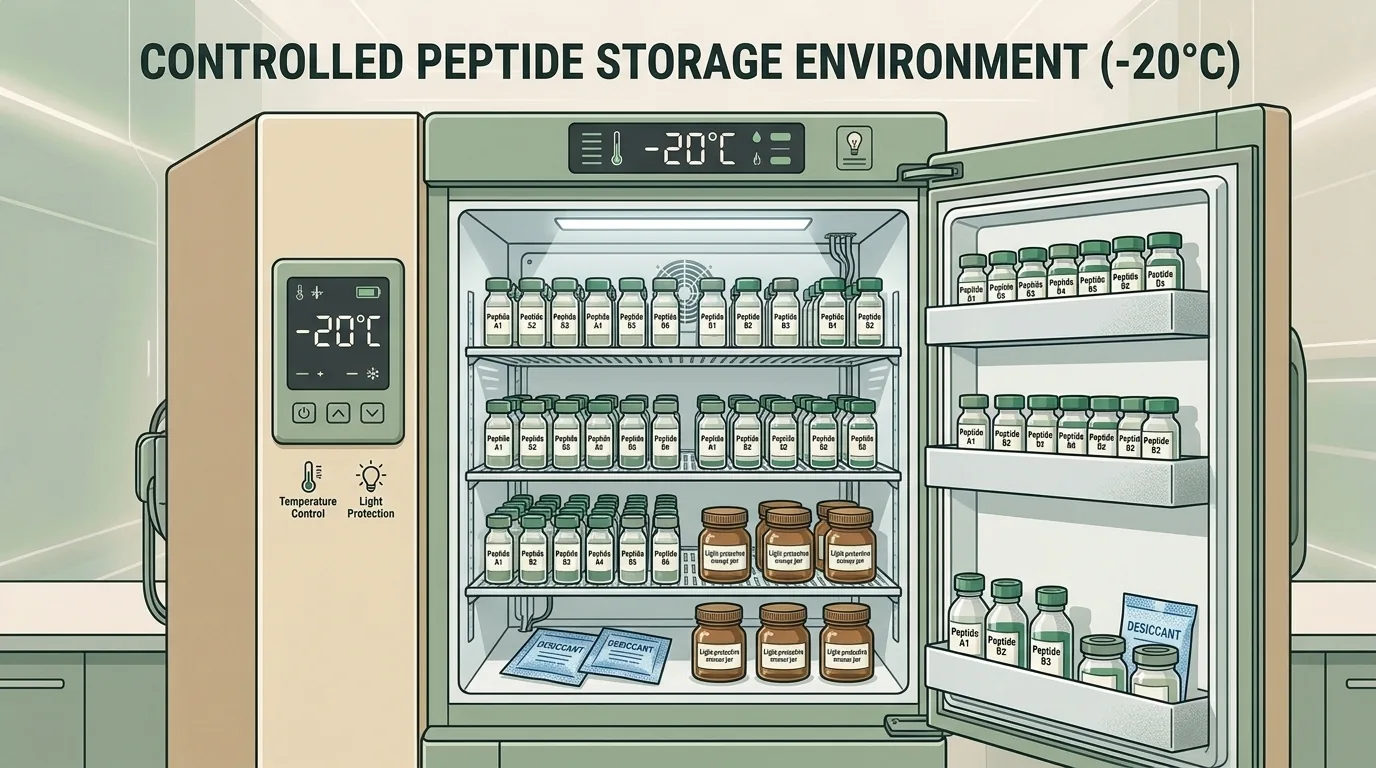
The storage requirements for peptides change significantly depending on their physical state. Understanding the difference between lyophilized (freeze-dried) and reconstituted (dissolved in solution) peptides is the foundation of proper handling.
| Factor | Lyophilized (Powder) | Reconstituted (Solution) |
|---|---|---|
| Recommended temperature | -20°C or below | 2–8°C (refrigerated) |
| Stability window | Months to years if sealed properly | Days to weeks depending on compound |
| Moisture sensitivity | High — must be kept dry | Already in solution |
| Freeze-thaw tolerance | Tolerant if sealed | Sensitive — minimize cycles |
| Light sensitivity | Moderate | High — degradation accelerates in solution |
Temperature Management
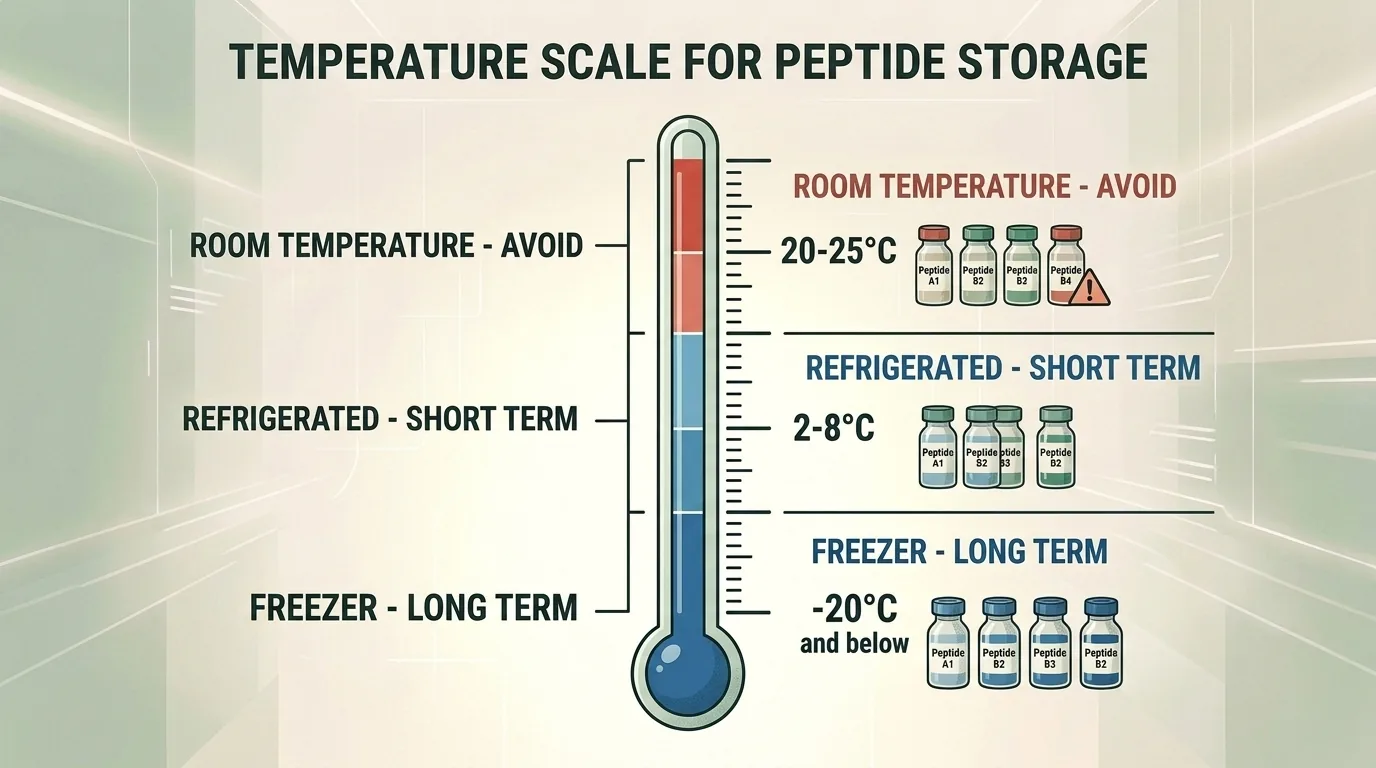
Temperature is the single most impactful storage variable. Peptide bonds are thermodynamically stable at low temperatures but become increasingly susceptible to hydrolysis, oxidation, and aggregation as temperature rises.
Long-Term Storage: -20°C or Below
Lyophilized peptides should be stored at -20°C (standard laboratory freezer) or colder for long-term preservation. At these temperatures, molecular motion is minimized, significantly slowing degradation pathways.
Short-Term and Working Storage: 2–8°C
Reconstituted peptides and lyophilized vials in active use can be stored at refrigerator temperatures (2–8°C) for short periods. However, this is a compromise — degradation is slowed but not halted.
Light Protection
UV and visible light exposure can trigger photodegradation — breaking peptide bonds and oxidizing sensitive amino acid residues (particularly tryptophan, tyrosine, and methionine). Standard precautions include:
- Store vials in opaque or amber containers when possible
- Keep peptides in original packaging until ready for use
- Minimize exposure to direct fluorescent or natural light during handling
- Wrap reconstituted vials in aluminum foil if extended storage is necessary
Reconstitution Best Practices
Reconstitution — dissolving lyophilized peptide in a suitable solvent — requires careful technique to preserve compound integrity:
- Choose the right solvent — Bacteriostatic water (BAC water) is standard for most peptides. Some compounds require specific solvents; check the product documentation.
- Add solvent gently — Direct the solvent stream against the vial wall, not directly onto the lyophilized cake. This prevents foaming and denaturation.
- Do not shake — Swirl the vial gently or roll it between your palms. Vigorous shaking introduces air and can denature the peptide.
- Allow time to dissolve — Some peptides dissolve instantly; others may need 5–10 minutes of gentle swirling. Do not force dissolution with heat.
- Use immediately or refrigerate — Once reconstituted, store at 2–8°C and use within the compound’s documented stability window.
Each freeze-thaw cycle subjects peptides in solution to ice crystal formation, which can physically disrupt molecular structure. Additionally, the repeated temperature transitions accelerate oxidation and aggregation.
Best practice: If you need to store reconstituted peptide for extended periods, aliquot the solution into single-use portions before freezing. This way, you only thaw what you need each time, avoiding repeated cycling of the entire supply.
Shipping and Transit Considerations
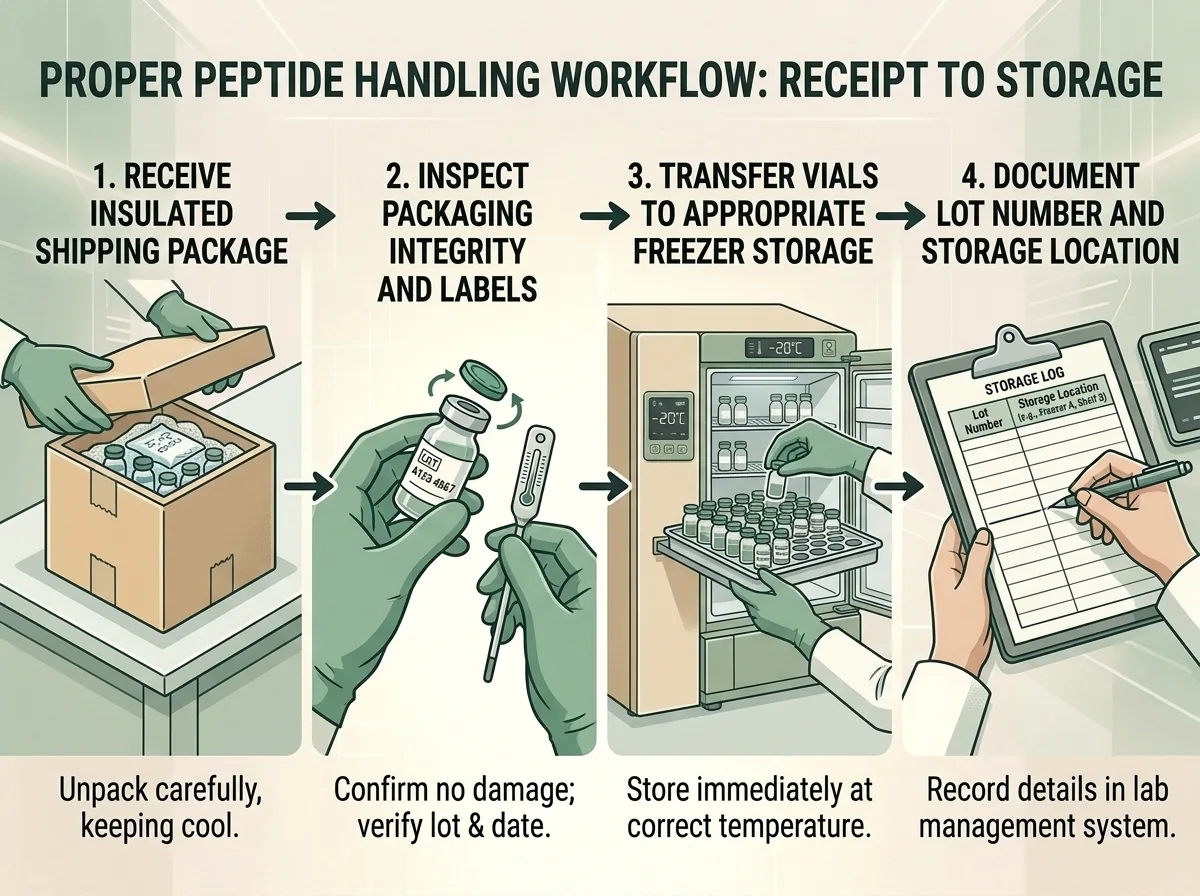
The storage chain begins at the supplier, not the researcher. Responsible suppliers account for transit conditions by:
- Shipping lyophilized peptides (not reconstituted) for maximum transit stability
- Using insulated packaging to buffer temperature fluctuations
- Selecting expedited shipping methods to minimize time in transit
- Including cold packs or dry ice for temperature-sensitive shipments
Key Takeaways
Key Takeaways
- Lyophilized peptides are far more stable than reconstituted solutions — keep them in powder form until needed
- Store lyophilized peptides at -20°C; reconstituted peptides at 2–8°C
- Protect all peptides from light, moisture, and temperature fluctuations
- Reconstitute gently — direct solvent against the vial wall, swirl don’t shake
- Minimize freeze-thaw cycles by aliquoting reconstituted peptides into single-use portions
- The storage chain starts with the supplier — proper transit handling is part of the quality equation
Frequently Asked Questions
Most lyophilized peptides remain stable for 12–24 months at -20°C when properly sealed and protected from moisture. Some compounds may be stable longer, but this varies by sequence and storage conditions. Check the product documentation for compound-specific guidance.
It is possible but not recommended for repeated cycles. If you must freeze reconstituted peptide, aliquot it into single-use portions first to avoid repeated freeze-thaw cycling of the full supply.
Brief exposure (hours) is generally acceptable for lyophilized peptides, as the dry powder form provides inherent stability. Extended exposure (days) or exposure of reconstituted solutions to elevated temperatures can cause measurable degradation.
Browse Research-Grade Peptides
All MHS Longevity compounds are shipped in lyophilized form with insulated packaging and cold chain protocols.
Shop Peptides