
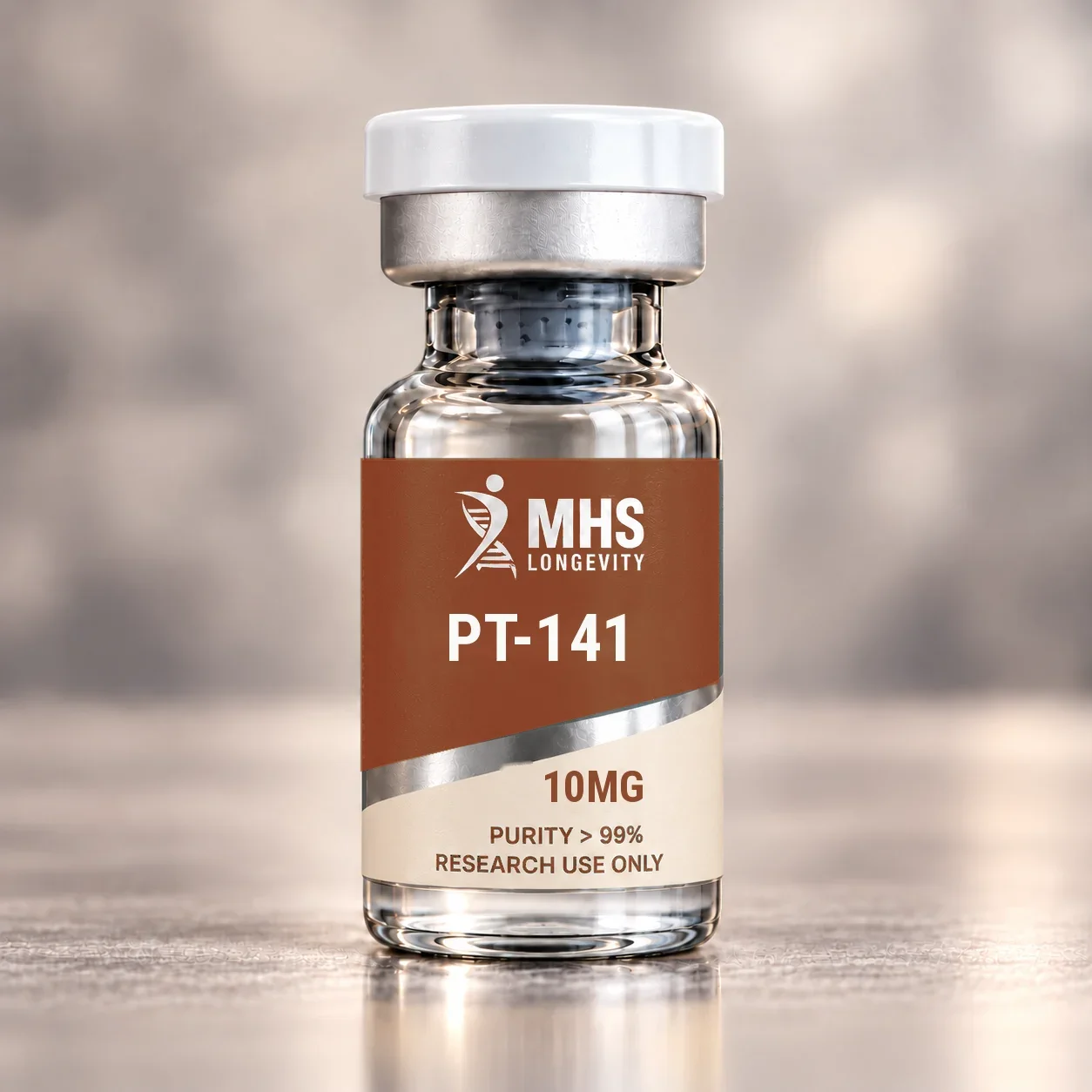
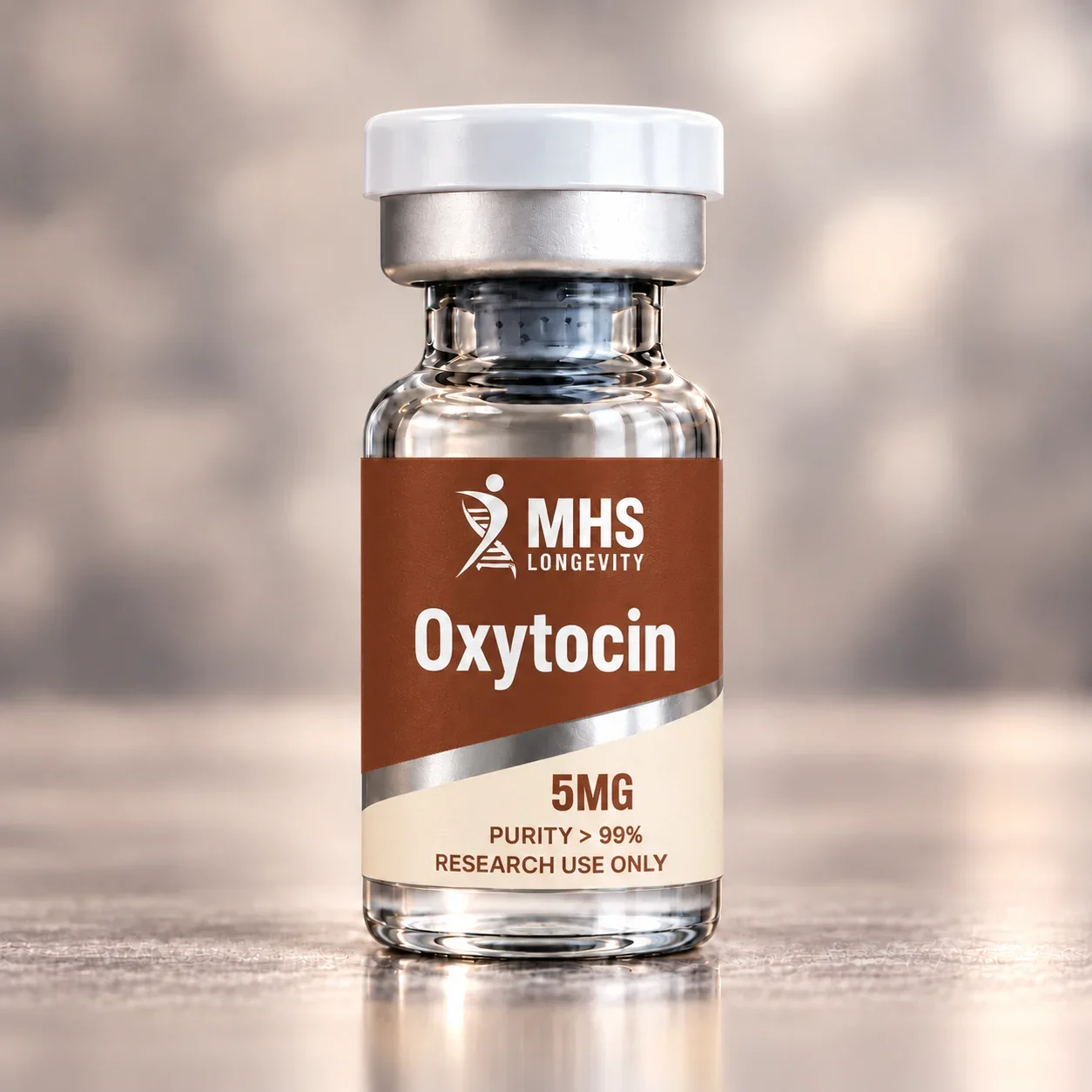
Oxytocin 5mg
A connection-focused peptide researched for social bonding, emotional warmth, and calmer stress response.
- 99%+ purity verified by independent HPLC + Mass Spec
- Certificate of Analysis published — match it to your vial
- Ships from US facility · Free shipping over $150
$44.99
In stock — ships within 24h
For laboratory research use only. Not for human consumption.
Batch verification✓ Verified
- Purity (HPLC)
- >99.3%
- Method
- HPLC + MS
Storage & handling+
Lyophilized Oxytocin should be stored at -20°C or below for extended stability. Once reconstituted in bacteriostatic water, the solution is typically held at 2–8°C and used within the documented stability window. Oxytocin is comparatively labile in solution — the disulfide bond is sensitive to reducing conditions and the molecule degrades faster than many other nonapeptides at room temperature. Single-use aliquoting after reconstitution is good practice. Contact with reducing-agent residues (DTT, TCEP, mercaptoethanol on glassware) should be avoided. Standard aseptic technique applies. For laboratory research use only.
Shipping & delivery+
Orders placed before 2pm ET ship the same business day from our US facility. Standard (2–4 days) or expedited options available. Free standard US shipping on orders over $150. Plain, unbranded packaging. Full shipping policy
Returns & damage policy+
Damaged or non-conforming orders are reshipped at no cost — contact support with a photo within 7 days of delivery. See our full returns policy for details. Full returns policy
We accept


Used in Brain Health Protocol and Sexual Health Protocol.
HPLC tested
99%+ purity verified
Public COAs
Third-party certificates
Veteran-owned
US-based fulfillment
Free shipping
On orders over $150
Overview
Description
A connection-focused peptide researched for social bonding, emotional warmth, and calmer stress response. Often chosen to support interpersonal ease and mood balance in high-demand environments.
Oxytocin is commonly explored in research for emotional regulation and behavioral resilience pathways— useful when the goal is a smoother, more connected state without stimulant effects.
Scientific Overview
Oxytocin is a neuropeptide studied for its role in affiliative behavior, social bonding, and stress-response modulation. Research applications include neurobehavioral signaling, emotional processing circuits, and autonomic regulation in controlled settings. It remains a major focus in social cognition and resilience-related research.
Product Details
- Compound: Oxytocin
- Vial Size: 5mg
- Purity: ≥99%
- Form: Lyophilized powder
This product is intended strictly for laboratory research purposes only. It is not approved for human or veterinary use by the FDA or any other regulatory agency. Store in a cool, dry environment prior to reconstitution and handle using appropriate laboratory and aseptic techniques.
Frequently asked questions
Yes. Every batch of Oxytocin 5mg undergoes independent third-party testing using High-Performance Liquid Chromatography (HPLC) and Mass Spectrometry (MS). The Certificate of Analysis is published and accessible from the product page.
Oxytocin 5mg sold by MHS Longevity is verified to 99%+ purity, with the result documented in each batch's Certificate of Analysis. Anything below that threshold is rejected before release.
The Certificate of Analysis for Oxytocin 5mg is available directly from the product page and on our Third-Party Test Results page. Each COA includes the batch identifier, test date, testing method, and verified purity percentage.
Oxytocin 5mg ships from our US-based facility with standard or expedited options. Orders over $150 qualify for free standard US shipping. All orders are packaged discreetly with documented handling protocols.
No. Oxytocin 5mg is supplied strictly for laboratory research purposes only. It is not approved by the FDA for human or veterinary use, and it is not intended to diagnose, treat, cure, or prevent any disease.
MHS Longevity is a veteran-owned operation focused on pharmaceutical-grade research compounds. We source from vetted manufacturers, batch-test independently with HPLC and Mass Spectrometry, and publish every Certificate of Analysis. Pricing is transparent and the testing process is documented end-to-end.
Oxytocin has a molecular weight of approximately 1007.2 g/mol in its oxidized, C-terminally amidated form. The reduced (open-disulfide) form is 2 Da heavier; the free-acid form is 1 Da heavier. Mass Spectrometry on each batch confirms the correctly oxidized and amidated species.
Both are nine-residue cyclic neurohypophyseal hormones with the same disulfide-loop architecture. They differ at two positions: Oxytocin has Ile3 and Leu8; vasopressin has Phe3 and Arg8 (or Lys8 in lysine-vasopressin). Those two substitutions are sufficient to switch receptor selectivity from OXTR to the vasopressin receptors (V1A, V1B, V2). Despite the structural similarity, Oxytocin and vasopressin have substantially different pharmacology in the published literature.
FDA-approved pharmaceutical preparations of oxytocin are formulated injectable products produced under pharmaceutical-manufacturing standards and distributed through prescription channels for specific clinical indications. Research-grade Oxytocin supplied here is a lyophilized peptide for laboratory study only — not formulated, not pharmaceutical-grade, and not approved for human use. The active molecule is the same; the regulatory pathway, formulation, and intended use are entirely different.
Oxytocin is sent to an independent third-party laboratory for HPLC and Mass Spectrometry analysis before each batch is released. The lab's identifier and test date are published on the Certificate of Analysis for that batch, including the mass shifts that confirm the disulfide and C-terminal amide.
You may also like
Research & buying
The evidence behind Oxytocin 5mg and the questions to ask any vendor before you order.
Research details — Oxytocin 5mg
Oxytocin is a nonapeptide neurohypophyseal hormone, first chemically isolated in 1953 by Vincent du Vigneaud — work that earned the 1955 Nobel Prize in Chemistry as the first synthesis of a polypeptide hormone. The endogenous molecule is produced in the hypothalamus, transported to the posterior pituitary, and released into circulation; it acts on the oxytocin receptor (OXTR), a G-protein-coupled receptor expressed in reproductive tissues, mammary epithelium, and several central-nervous-system regions. This guide covers what Oxytocin is, the published research context, and how its quality is independently verified.
What is Oxytocin?
Oxytocin has the sequence Cys-Tyr-Ile-Gln-Asn-Cys-Pro-Leu-Gly-NH2 with an intramolecular disulfide bond between the two cysteine residues (positions 1 and 6) and a C-terminal amide. The cyclized structure produces a six-membered ring with a three-residue tail, a configuration shared with the structurally related hormone vasopressin (which differs in just two residues). The molecular weight is approximately 1007.2 g/mol. It is supplied as a lyophilized white powder for laboratory reconstitution.
Research context
Published research on Oxytocin spans the molecule's classical roles in parturition and lactation, its more recently characterized roles in social-behavior and pair-bonding research (work that drew from rodent-model and primate studies in the 2000s and 2010s), and its activity in cardiovascular and metabolic models. The receptor pharmacology is well-characterized — OXTR is a Gq-coupled GPCR with substantial cross-reactivity at vasopressin receptors at higher concentrations, which researchers should account for when designing selectivity-dependent experiments. Researchers should evaluate primary sources directly.
How Oxytocin quality is verified
Every batch of MHS Longevity Oxytocin is submitted to an independent third-party laboratory before release. The disulfide bond and the C-terminal amide are both specific verification targets:
- HPLC separates components by chemistry. Reduced (open-disulfide) Oxytocin and oxidized (closed-disulfide) forms elute at distinguishable retention times. Free-acid (deamidated) variants also separate cleanly. Anything below 99% target is rejected.
- Mass Spectrometry confirms both the disulfide bond (via the -2 Da mass shift relative to the reduced form) and the C-terminal amide (via the -1 Da shift relative to the free-acid form). For a nonapeptide with two specific structural modifications, MS provides clean readouts on both.
What an Oxytocin Certificate of Analysis shows
- Compound name and structural designation. Oxytocin, with full 9-residue sequence, disulfide bond notation (Cys1–Cys6), and C-terminal amide.
- Batch identifier. Unique ID linking certificate to vial.
- Test date. When the analysis was performed.
- Method. HPLC, MS, or both, with column and mobile-phase notes.
- Verified purity %. The HPLC result. We require 99%+.
- Disulfide and amide confirmation. MS mass shifts confirm both modifications are intact.
- Lab and signatures. The independent lab performing the analysis.
Storage and handling (research lab context)
Lyophilized Oxytocin should be stored at -20°C or below for extended stability. Once reconstituted in bacteriostatic water, the solution is typically held at 2–8°C and used within the documented stability window. Oxytocin is comparatively labile in solution — the disulfide bond is sensitive to reducing conditions and the molecule degrades faster than many other nonapeptides at room temperature. Single-use aliquoting after reconstitution is good practice. Contact with reducing-agent residues (DTT, TCEP, mercaptoethanol on glassware) should be avoided. Standard aseptic technique applies.
Further reading
Where to buy Oxytocin 5mg
The same eight questions apply whether you're buying Oxytocin 5mg from us or anywhere else. Vendors who can't answer any of them are worth a closer look.
Vendor evaluation checklist
1. Is the Certificate of Analysis public and downloadable?
A vendor unwilling to publish HPLC/MS results for the batch you're buying has nothing to verify their purity claim against.
2. Which testing method was used — HPLC, Mass Spectrometry, or both?
HPLC measures purity. Mass Spectrometry confirms the molecule's identity. Reputable batches go through both.
3. What's the verified purity percentage on the published COA?
Industry research standard is 99%+. Below that, you're paying for a compound diluted with synthesis byproducts.
4. Where does the product ship from?
US-based fulfillment generally means shorter handling times, customs-free delivery, and clearer return remedies.
5. Is the price published at a single list rate, or hidden behind tier locks?
Opaque pricing is a yellow flag. Transparent vendors quote the same number to every customer.
6. What's the free-shipping threshold, if any?
Compare the all-in cost (product + shipping + handling) — not just the headline price.
7. How is the product stored prior to shipment?
Lyophilized peptides degrade with temperature swings. Vendors should disclose temperature-controlled storage.
8. Is there a documented damage-claim and return policy?
Discreet shipping carries handling risk. A clear, written policy protects you when something goes wrong.
MHS LongevityThis site - Price
- $44.99
- Purity
- 99%+
- Testing
- HPLC + MS
- COA public
- US-based
- Free shipping
- $150+
- Last checked
- Oct 10, 2026
| Vendor | Price | Listed purity | Testing method | COA public | US-based | Free shipping | Last checked |
|---|---|---|---|---|---|---|---|
MHS LongevityThis site | $44.99 | 99%+ | HPLC + MS | $150+ | Oct 10, 2026 |
Competitor data sourced from each vendor's public product page on the date shown. Listed purity reflects each vendor's own published claim; Certificate of Analysis availability is verified at the URL above. Data may have changed since last check.