
Introduction
In the world of advanced wellness and longevity research, few compounds have generated as much interest as GHK-Cu. Known for its role in regenerative signaling, this copper-binding peptide has become widely discussed for its potential impact on skin quality, tissue repair, and hair health. Understanding GHK-Cu benefits requires looking beyond surface-level claims and into how it interacts with biological systems.
Unlike traditional supplements, peptides like GHK-Cu function as signaling molecules. This means they help regulate processes such as collagen production, inflammation response, and cellular repair. These mechanisms are what make GHK-Cu particularly interesting in research related to aging and recovery.
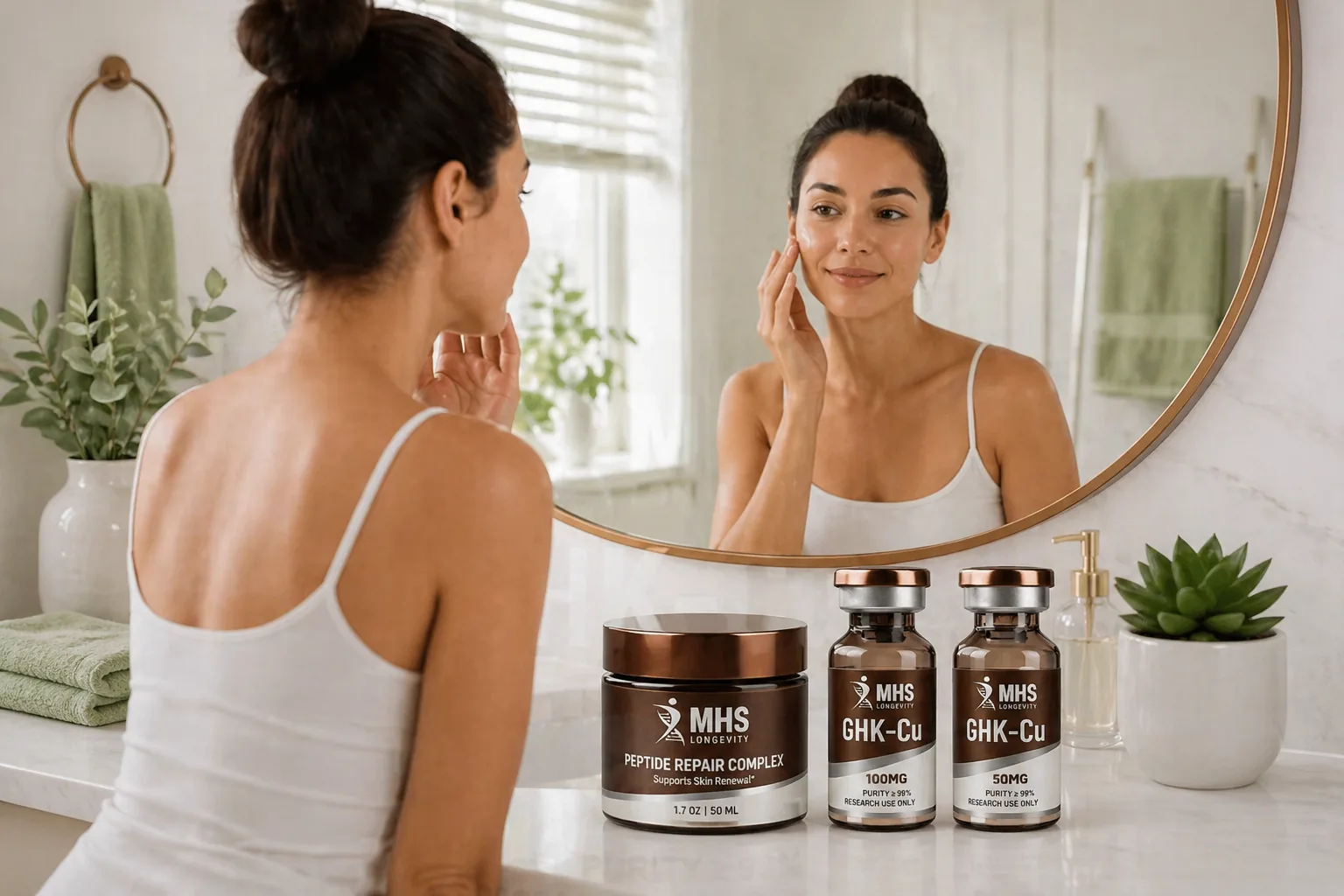
MHS Longevity focuses on high-purity, research-grade peptides, making it easier to explore compounds like GHK-Cu within a structured and science-driven framework.
TLDR Quick Guide
- GHK-Cu is a copper peptide involved in cellular signaling
- Commonly studied for skin repair and hair support
- Supports collagen production and tissue regeneration pathways
- Often researched in longevity and recovery protocols
- Quality and purity are critical when evaluating peptides
What Is GHK-Cu and Why Is It Unique
A Naturally Occurring Peptide
GHK-Cu is a naturally occurring peptide found in the human body, particularly in plasma, saliva, and urine. It binds with copper ions, which play a role in various enzymatic and repair processes.
As we age, natural levels of GHK-Cu decline. This reduction is one reason it has become a focus in longevity-related research.
Its ability to influence multiple biological pathways makes it distinct from traditional single-function compounds.
A Signaling Molecule, Not a Supplement
Unlike vitamins or minerals, GHK-Cu doesn’t simply “add” nutrients. Instead, it signals the body to activate certain processes.
This includes pathways related to tissue repair, inflammation control, and cellular regeneration. Because of this, it is often categorized within advanced research compounds rather than standard wellness products.
This signaling function is what makes peptides fundamentally different.
GHK-Cu Benefits for Skin Support
Supporting Collagen and Skin Structure
One of the most widely discussed GHK-Cu benefits is its role in supporting collagen-related pathways. Collagen is essential for maintaining skin firmness and elasticity.
Research interest centers around how GHK-Cu may influence the body’s natural ability to maintain structural proteins. This is especially relevant in aging-related studies.
Healthier collagen signaling is associated with smoother, more resilient skin appearance.
Promoting Tissue Repair Processes
GHK-Cu has also been studied for its involvement in tissue remodeling and repair signaling. These processes are essential for maintaining healthy skin over time.
By supporting cellular communication, GHK-Cu may help regulate how the body responds to environmental stressors. This includes oxidative stress and inflammation.
These pathways are key components in long-term skin health research.
GHK-Cu Benefits for Hair Support
Encouraging Healthy Follicle Environment
Hair health is closely tied to the condition of the scalp and underlying follicles. GHK-Cu has been studied for its role in supporting a healthier biological environment for these structures.
This includes pathways related to blood flow, nutrient delivery, and inflammation control. A balanced scalp environment is essential for maintaining hair quality.
These factors make it a point of interest in hair-related research.
Supporting Regenerative Signaling
GHK-Cu’s role in regenerative signaling extends to hair-related pathways as well. It is often explored for how it may influence cellular turnover and repair mechanisms.
Healthy regeneration is essential for maintaining hair density and strength. While results vary depending on context, this is a key reason for its growing popularity.
It’s part of a broader category of compounds focused on structural support.
Why GHK-Cu Is Popular in Longevity Research
Connection to Aging and Cellular Health
As interest in longevity grows, compounds that influence cellular repair are receiving more attention. GHK-Cu fits into this category due to its involvement in regenerative processes.
It is often studied alongside other compounds found in longevity research collections that focus on aging and cellular optimization.
This positions it as part of a larger strategy rather than a standalone solution.
Multi-System Influence
One of the key reasons GHK-Cu stands out is its ability to impact multiple systems. Rather than targeting a single function, it interacts with pathways related to skin, inflammation, and tissue repair.
This multi-system influence is valuable in research exploring whole-body optimization. It aligns with the idea of improving overall biological efficiency.
This broad scope increases its relevance in advanced protocols.
The Importance of Quality and Purity
Why Source Matters
With peptides, quality is not optional—it’s essential. Impurities or inconsistencies can affect research outcomes and reliability.
MHS Longevity emphasizes high-purity, third-party tested compounds, ensuring consistency across batches. This level of quality control is critical in peptide research.
Choosing the right source directly impacts results.
Structured Research Categories
GHK-Cu is often explored within broader categories such as skin and hair research and inflammation and gut health research , depending on the focus.
This structured approach helps users understand how different compounds fit into larger protocols. It also simplifies decision-making for those exploring advanced research topics.
Organization and clarity are key when working with complex compounds.
How GHK-Cu Fits Into a Broader Protocol
Not a Standalone Solution
GHK-Cu is rarely used in isolation within research contexts. It is typically part of a broader protocol that includes multiple compounds targeting different pathways.
For example, combining structural support compounds with metabolic or recovery-focused peptides creates a more comprehensive approach.
This layered strategy is common in advanced optimization research.
Aligning With Research Goals
The effectiveness of any compound depends on how well it aligns with the intended goal. Whether the focus is skin health, recovery, or longevity, GHK-Cu must be evaluated within that context.
Understanding your objective ensures better outcomes and more meaningful results. This applies to all peptide research.
Clarity of purpose leads to better decisions.
Key Takeaways
- GHK-Cu benefits center around cellular signaling and regeneration
- It is widely studied for skin structure and hair-related pathways
- Functions differently from traditional supplements
- Plays a role in broader longevity and repair research
- Quality and sourcing are critical for reliable outcomes
Frequently Asked Questions
What is GHK-Cu used for?
GHK-Cu is studied for its role in cellular repair and regenerative signaling. It is commonly associated with skin and hair research. Its applications extend to broader longevity-focused studies.
How does GHK-Cu work?
GHK-Cu functions as a signaling peptide that influences biological processes. It helps regulate pathways related to collagen, inflammation, and repair. This makes it different from traditional supplements.
Why is GHK-Cu popular for skin research?
It is often studied for its involvement in collagen-related pathways and tissue repair. These processes are essential for maintaining skin structure. Its multi-functional nature increases its relevance.
Is GHK-Cu used alone or with other compounds?
It is typically used as part of a broader research protocol. Combining it with other compounds allows for more comprehensive pathway targeting. This approach is common in advanced studies.
Why is purity important for peptides like GHK-Cu?
Peptides require precise formulation and testing to ensure consistency. Impurities can affect reliability and outcomes. High-quality sourcing ensures more accurate research results.