
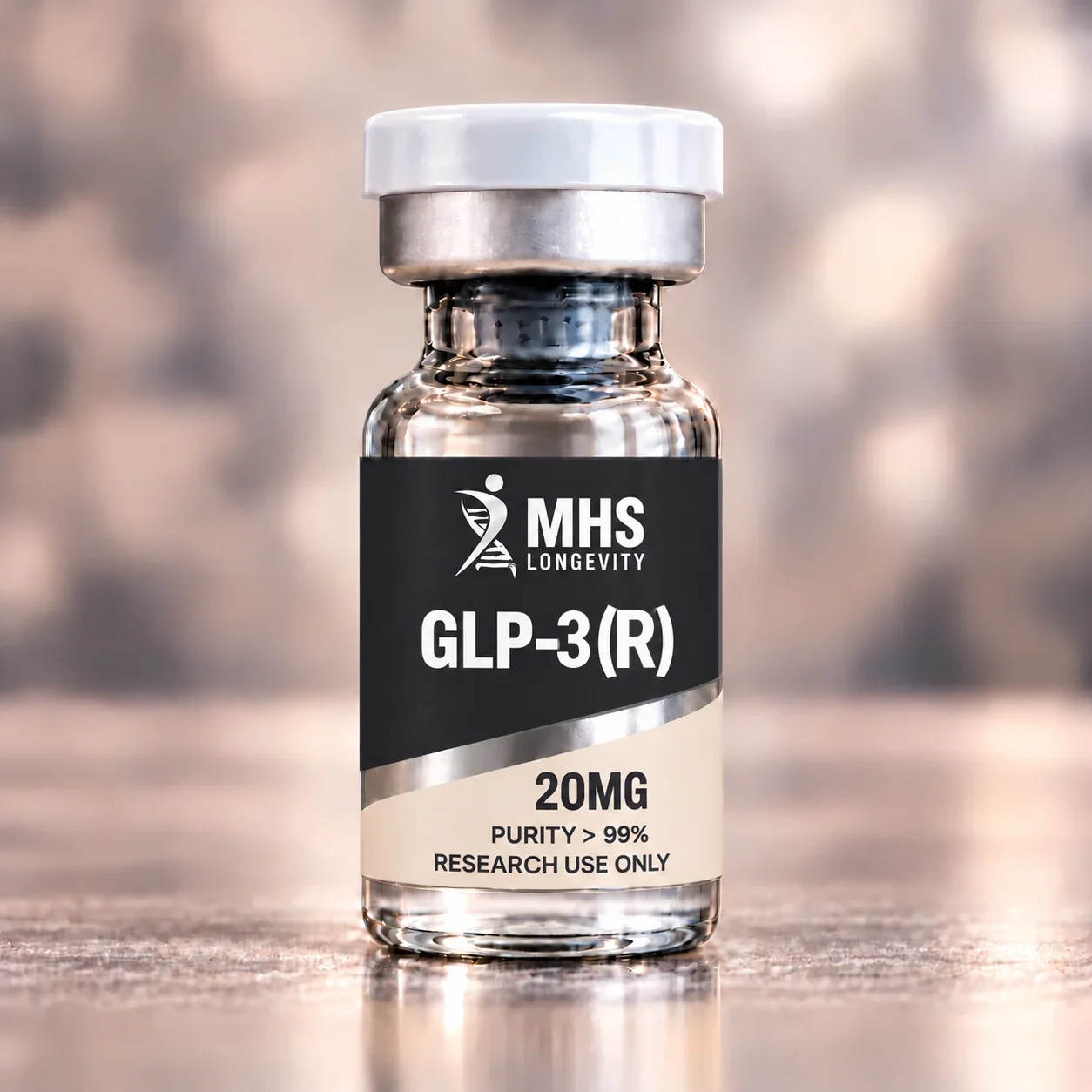
GLP-3 (R) 20mg
An advanced metabolic peptide researched for appetite control, reduced cravings, and high-level satiety support.
- 99%+ purity verified by independent HPLC + Mass Spec
- Certificate of Analysis published — match it to your vial
- Ships from US facility · Free shipping over $150
$224.99
In stock — ships within 24h
For laboratory research use only. Not for human consumption.
Batch verification✓ Verified
- Purity (HPLC)
- 99.5%
- Method
- HPLC + MS
Storage & handling+
Lyophilized Retatrutide should be stored at -20°C or below for extended stability. Once reconstituted in bacteriostatic water, the solution is typically held at 2–8°C and used within the documented stability window. The lipid-modified architecture is sensitive to extreme pH and repeated thermal cycling, so single-use aliquoting is good practice. Standard aseptic technique applies during reconstitution. For laboratory research use only.
Shipping & delivery+
Orders placed before 2pm ET ship the same business day from our US facility. Standard (2–4 days) or expedited options available. Free standard US shipping on orders over $150. Plain, unbranded packaging. Full shipping policy
Returns & damage policy+
Damaged or non-conforming orders are reshipped at no cost — contact support with a photo within 7 days of delivery. See our full returns policy for details. Full returns policy
We accept


Used in Weight Loss Protocol.
HPLC tested
99%+ purity verified
Public COAs
Third-party certificates
Veteran-owned
US-based fulfillment
Free shipping
On orders over $150
Overview
Description
An advanced metabolic peptide researched for appetite control, reduced cravings, and high-level satiety support. Often chosen when someone wants a next-step approach to metabolic efficiency and body-composition research.
Retatrutide is commonly discussed in research for multi-pathway metabolic signaling, supporting disciplined nutrition habits and refined body-shaping goals.
Scientific Overview
Retatrutide is an investigational multi-pathway peptide studied for its effects on appetite signaling, glucose regulation, and energy balance. Research interest centers on its activity across multiple receptor targets involved in satiety and metabolic output in experimental models. These multi-receptor pathways are a major focus in advanced obesity and metabolic research.
Product Details
- Compound: Retatrutide (GLP-3 (R))
- Vial Size: 20mg
- Purity: ≥99%
- Form: Lyophilized powder
This product is intended strictly for laboratory research purposes only. It is not approved for human or veterinary use by the FDA or any other regulatory agency. Store in a cool, dry environment prior to reconstitution and handle using appropriate laboratory and aseptic techniques.
Frequently asked questions
Yes. Every batch of GLP-3 (R) 20mg undergoes independent third-party testing using High-Performance Liquid Chromatography (HPLC) and Mass Spectrometry (MS). The Certificate of Analysis is published and accessible from the product page.
GLP-3 (R) 20mg sold by MHS Longevity is verified to 99%+ purity, with the result documented in each batch's Certificate of Analysis. Anything below that threshold is rejected before release.
The Certificate of Analysis for GLP-3 (R) 20mg is available directly from the product page and on our Third-Party Test Results page. Each COA includes the batch identifier, test date, testing method, and verified purity percentage.
GLP-3 (R) 20mg ships from our US-based facility with standard or expedited options. Orders over $150 qualify for free standard US shipping. All orders are packaged discreetly with documented handling protocols.
No. GLP-3 (R) 20mg is supplied strictly for laboratory research purposes only. It is not approved by the FDA for human or veterinary use, and it is not intended to diagnose, treat, cure, or prevent any disease.
MHS Longevity is a veteran-owned operation focused on pharmaceutical-grade research compounds. We source from vetted manufacturers, batch-test independently with HPLC and Mass Spectrometry, and publish every Certificate of Analysis. Pricing is transparent and the testing process is documented end-to-end.
Retatrutide engages three distinct receptors — the GLP-1 receptor, the GIP receptor, and the glucagon receptor. The pharmacology of simultaneous activation across these three pathways is the central feature being studied in the published literature, and is what distinguishes retatrutide from dual-agonist molecules like tirzepatide (GLP-1 + GIP) and single-agonist molecules like semaglutide (GLP-1 only).
No. Retatrutide is currently in clinical investigation and is not approved by the FDA for any therapeutic use. It is supplied by MHS Longevity strictly for laboratory research. Researchers tracking the regulatory pipeline should consult ClinicalTrials.gov and the latest Eli Lilly investor and regulatory disclosures.
Retatrutide is sent to an independent third-party laboratory for HPLC and Mass Spectrometry analysis before each batch is released. The lab's identifier and test date are published on the Certificate of Analysis for that batch.
Retatrutide's published structure carries enough non-standard chemistry that we prefer to document the exact molecular weight, monoisotopic mass, and side-chain notation on each batch's Certificate of Analysis rather than rely on a general guide value. Researchers should reference the COA for the specific batch they are using.
You may also like
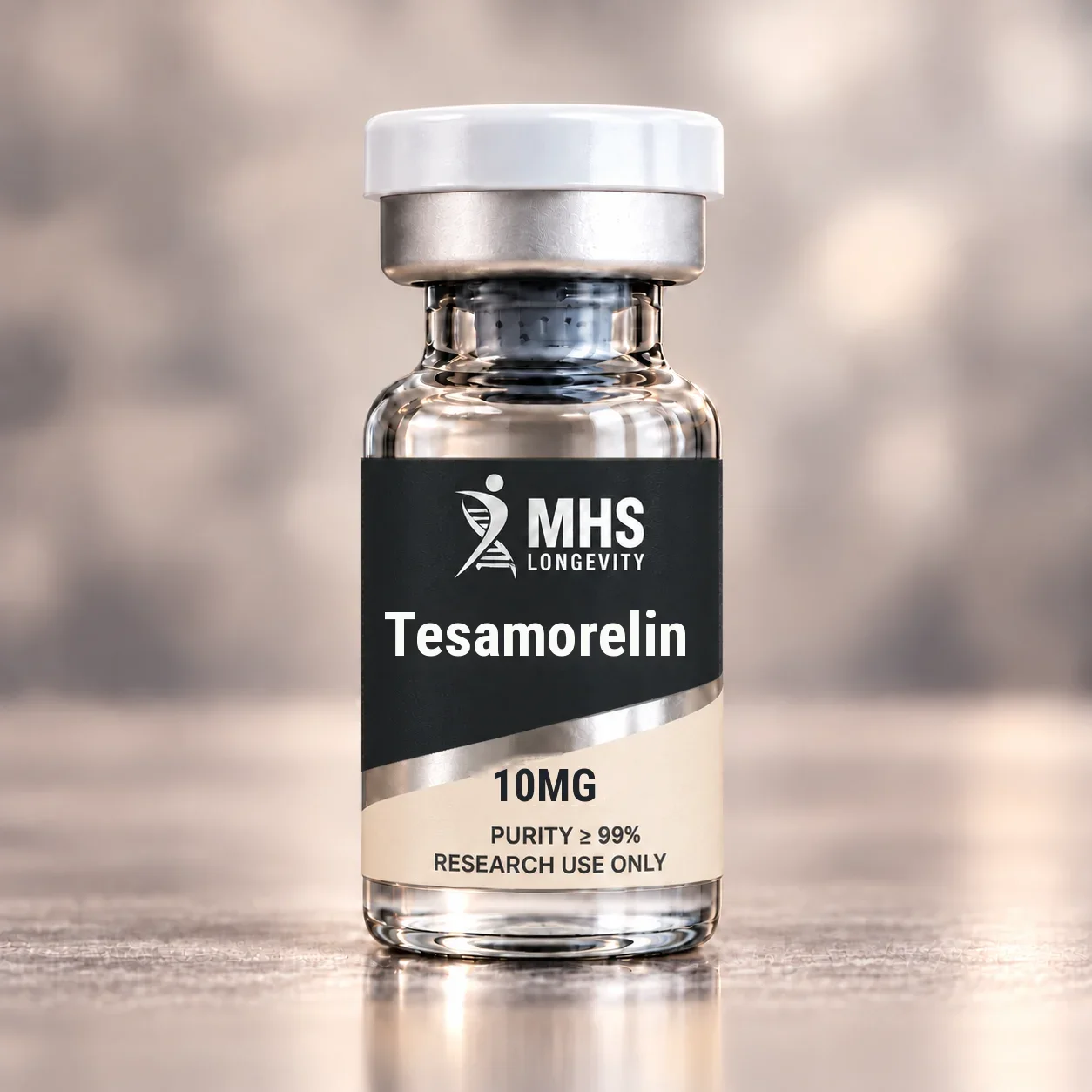
Research & buying
The evidence behind GLP-3 (R) 20mg and the questions to ask any vendor before you order.
Research details — GLP-3 (R) 20mg
Retatrutide is a synthetic peptide designed as a triple-agonist active at the GLP-1, GIP, and glucagon receptors. It extends the multi-receptor design strategy of tirzepatide by adding glucagon-receptor engagement to the dual GLP-1 / GIP activity. As of the most recent literature, retatrutide remains in active clinical investigation; it is not an approved pharmaceutical product. The form supplied here is for laboratory research only.
What is Retatrutide?
Retatrutide is a linear synthetic peptide developed at Eli Lilly's research laboratories. It carries multiple non-standard amino-acid substitutions to support triple-receptor agonism and stability, and a fatty-acid side chain attached at a specific lysine residue via a γ-Glu spacer. The combined architecture is reported in the public Lilly research literature; researchers requiring exact sequence and modification notation should consult the original publications and each batch's Certificate of Analysis. The compound is supplied as a lyophilized off-white powder for laboratory reconstitution.
Research context
Published research on retatrutide examines the comparative pharmacology of triple-receptor agonism versus dual (GLP-1 / GIP) and single (GLP-1) incretin approaches. Preclinical work has investigated body-weight, glucose-handling, and lipid-metabolism endpoints in animal models; clinical-trial publications describe phase-1 and phase-2 results in specific patient populations. The molecule remains under active investigation; researchers should follow ClinicalTrials.gov and recent journal publications for the current evidence base.
How Retatrutide quality is verified
Retatrutide is structurally complex — multiple non-standard residues, a lipid modification, and a multi-receptor design imply higher synthesis difficulty than for shorter or unmodified peptides. Every batch of MHS Longevity Retatrutide is submitted to an independent third-party laboratory before release:
- HPLC separates components and measures the retatrutide peak as a percentage of total peak area. Anything below 99% is rejected.
- Mass Spectrometry confirms the full mass of the modified peptide. Because retatrutide carries non-standard residues and a lipid side chain, MS-confirmed identity at the batch level rules out partial-modification and substitution-mismatch errors that HPLC alone may not catch.
What a Retatrutide Certificate of Analysis shows
- Compound name and structural designation. Retatrutide, with sequence notation and the lipid modification documented.
- Batch identifier. The unique ID linking certificate to vial.
- Test date. When the analysis was performed.
- Method. HPLC, MS, or both, with column and mobile-phase notes.
- Verified purity %. The HPLC result. We require 99%+.
- Lab and signatures. The independent lab performing the analysis.
Storage and handling (research lab context)
Lyophilized Retatrutide should be stored at -20°C or below for extended stability. Once reconstituted in bacteriostatic water, the solution is typically held at 2–8°C and used within the documented stability window. The lipid-modified architecture is sensitive to extreme pH and repeated thermal cycling, so single-use aliquoting is good practice. Standard aseptic technique applies during reconstitution.
Where to buy GLP-3 (R) 20mg
The same eight questions apply whether you're buying GLP-3 (R) 20mg from us or anywhere else. Vendors who can't answer any of them are worth a closer look.
Vendor evaluation checklist
1. Is the Certificate of Analysis public and downloadable?
A vendor unwilling to publish HPLC/MS results for the batch you're buying has nothing to verify their purity claim against.
2. Which testing method was used — HPLC, Mass Spectrometry, or both?
HPLC measures purity. Mass Spectrometry confirms the molecule's identity. Reputable batches go through both.
3. What's the verified purity percentage on the published COA?
Industry research standard is 99%+. Below that, you're paying for a compound diluted with synthesis byproducts.
4. Where does the product ship from?
US-based fulfillment generally means shorter handling times, customs-free delivery, and clearer return remedies.
5. Is the price published at a single list rate, or hidden behind tier locks?
Opaque pricing is a yellow flag. Transparent vendors quote the same number to every customer.
6. What's the free-shipping threshold, if any?
Compare the all-in cost (product + shipping + handling) — not just the headline price.
7. How is the product stored prior to shipment?
Lyophilized peptides degrade with temperature swings. Vendors should disclose temperature-controlled storage.
8. Is there a documented damage-claim and return policy?
Discreet shipping carries handling risk. A clear, written policy protects you when something goes wrong.
MHS LongevityThis site - Price
- $224.99
- Purity
- 99%+
- Testing
- HPLC + MS
- COA public
- US-based
- Free shipping
- $150+
- Last checked
- Oct 10, 2026
| Vendor | Price | Listed purity | Testing method | COA public | US-based | Free shipping | Last checked |
|---|---|---|---|---|---|---|---|
MHS LongevityThis site | $224.99 | 99%+ | HPLC + MS | $150+ | Oct 10, 2026 |
Competitor data sourced from each vendor's public product page on the date shown. Listed purity reflects each vendor's own published claim; Certificate of Analysis availability is verified at the URL above. Data may have changed since last check.