
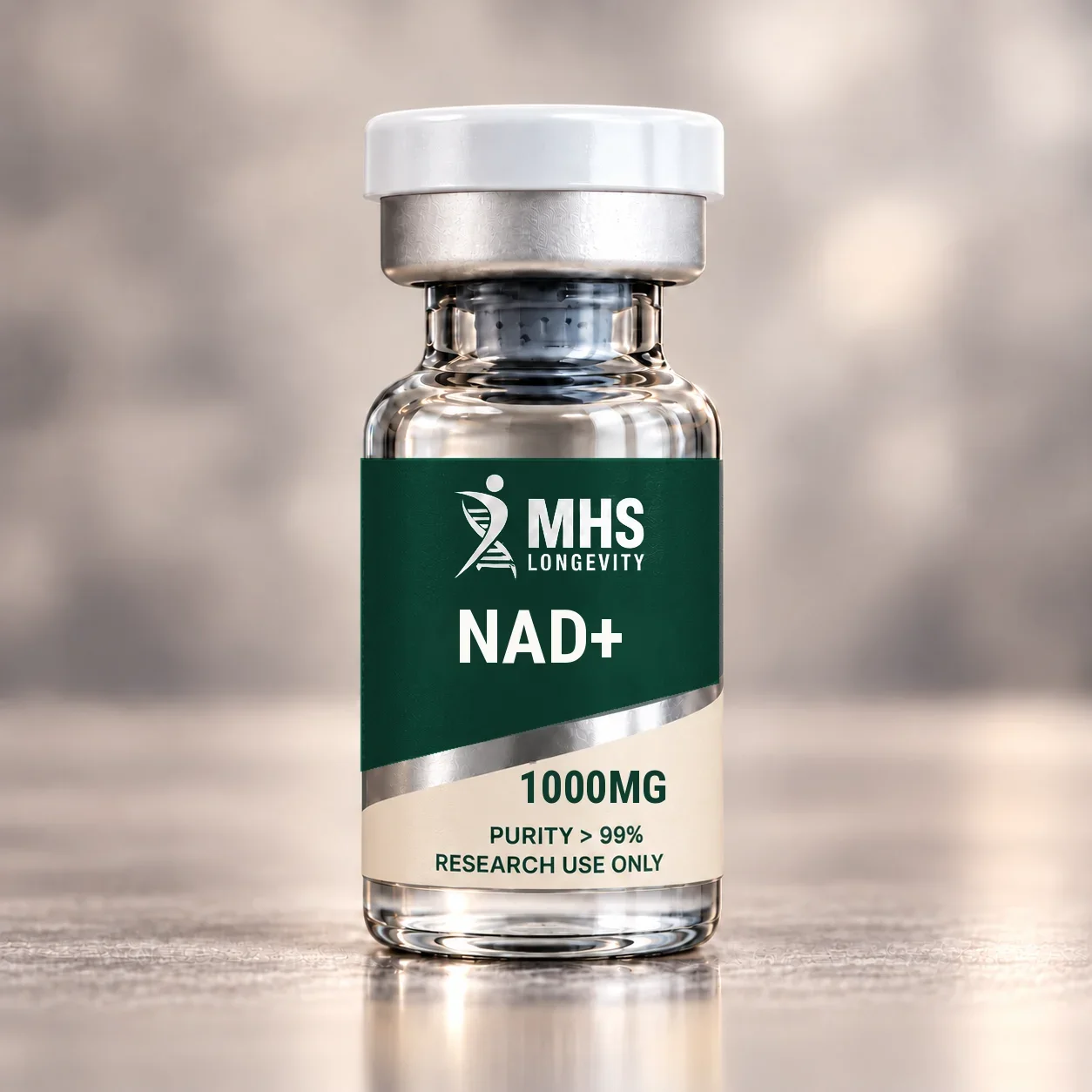
NAD 1000mg
A foundational longevity molecule researched for supporting cellular energy production, mitochondrial performance, and natural repair processes.
- 99%+ purity verified by independent HPLC + Mass Spec
- Certificate of Analysis published — match it to your vial
- Ships from US facility · Free shipping over $150
$149.99
In stock — ships within 24h
For laboratory research use only. Not for human consumption.
Batch verification✓ Verified
- Purity (HPLC)
- >99.4%
- Method
- HPLC + MS
Storage & handling+
Lyophilized NAD+ at -20°C is more sensitive to handling than most peptide products at the same temperature. For the 1000mg vial, immediate aliquoting after reconstitution becomes particularly important — the larger working volume yields more material that would otherwise sit in solution and equilibrate toward NADH. Aliquot into single-use volumes at -20°C, work under low-oxygen conditions where the protocol allows, and protect from light and moisture throughout handling. Standard aseptic technique applies. For laboratory research use only.
Shipping & delivery+
Orders placed before 2pm ET ship the same business day from our US facility. Standard (2–4 days) or expedited options available. Free standard US shipping on orders over $150. Plain, unbranded packaging. Full shipping policy
Returns & damage policy+
Damaged or non-conforming orders are reshipped at no cost — contact support with a photo within 7 days of delivery. See our full returns policy for details. Full returns policy
We accept


Used in Longevity Protocol.
HPLC tested
99%+ purity verified
Public COAs
Third-party certificates
Veteran-owned
US-based fulfillment
Free shipping
On orders over $150
Overview
Description
A foundational longevity molecule researched for supporting cellular energy production, mitochondrial performance, and natural repair processes.
NAD+ is commonly associated in research with mental clarity, steady energy, and healthy aging pathways— making it a popular core option in longevity-focused protocols.
Scientific Overview
Nicotinamide Adenine Dinucleotide (NAD+) is a naturally occurring coenzyme found in all living cells. It plays a central role in redox reactions that drive cellular energy metabolism and mitochondrial function. NAD+ also serves as a key substrate for enzymes involved in DNA repair and cellular signaling, which is why it remains a major focus in aging and metabolic research.
Product Details
- Compound: Nicotinamide Adenine Dinucleotide (NAD+)
- Vial Size: 1000mg
- Purity: ≥99%
- Form: Lyophilized powder
This product is intended strictly for laboratory research purposes only. It is not approved for human or veterinary use by the FDA or any other regulatory agency. Store in a cool, dry environment prior to reconstitution and handle using appropriate laboratory and aseptic techniques.
Frequently asked questions
Yes. Every batch of NAD 1000mg undergoes independent third-party testing using High-Performance Liquid Chromatography (HPLC) and Mass Spectrometry (MS). The Certificate of Analysis is published and accessible from the product page.
NAD 1000mg sold by MHS Longevity is verified to 99%+ purity, with the result documented in each batch's Certificate of Analysis. Anything below that threshold is rejected before release.
The Certificate of Analysis for NAD 1000mg is available directly from the product page and on our Third-Party Test Results page. Each COA includes the batch identifier, test date, testing method, and verified purity percentage.
NAD 1000mg ships from our US-based facility with standard or expedited options. Orders over $150 qualify for free standard US shipping. All orders are packaged discreetly with documented handling protocols.
No. NAD 1000mg is supplied strictly for laboratory research purposes only. It is not approved by the FDA for human or veterinary use, and it is not intended to diagnose, treat, cure, or prevent any disease.
MHS Longevity is a veteran-owned operation focused on pharmaceutical-grade research compounds. We source from vetted manufacturers, batch-test independently with HPLC and Mass Spectrometry, and publish every Certificate of Analysis. Pricing is transparent and the testing process is documented end-to-end.
No. Both vial sizes contain NAD+ drawn from the same supply chain and tested under the same HPLC + Mass Spectrometry protocol against the 99%+ purity specification. The only difference is the amount per vial.
When per-protocol NAD+ consumption exceeds 500mg before the post-reconstitution stability window closes, or when reducing the number of reconstitution events across an extended study delivers a meaningful stability benefit. For low-throughput cell-culture work, the 500mg vial is usually adequate.
Each reconstitution event briefly exposes the lyophilized material to ambient air and moisture, which initiates slow NAD+ → NADH equilibration and accumulates other degradation species. Peptide stability is less affected by these brief exposures because lyophilized peptides are more chemically robust. NAD+ specifically benefits from fewer such exposures across a research protocol.
Yes. Each batch has its own Certificate of Analysis regardless of vial size. The 1000mg COA documents the batch ID, test date, HPLC purity, and MS confirmation for the specific batch the vial was drawn from.
You may also like
Research & buying
The evidence behind NAD 1000mg and the questions to ask any vendor before you order.
Research details — NAD 1000mg
This guide covers the 1000mg vial format of NAD+ — the same dinucleotide coenzyme described in the dedicated 500mg guide (nicotinamide adenine dinucleotide, MW ~663.4 g/mol, formula C21H27N7O14P2), supplied at double the per-vial content. The molecule, its central role in cellular redox chemistry, and the proposed research mechanisms are identical to the 500mg form. What this guide adds is the practical context for protocols that consume more than 500mg before the reconstituted solution's stability window closes — and the specific stability-related reasons why a larger NAD+ vial benefits more than a larger peptide vial would.
When the 1000mg vial format makes sense
NAD+ research at scale has a distinctive profile compared to peptide research: per-experiment quantities tend to be larger because cellular NAD+ pools are themselves substantial, and protocols studying sustained NAD+ availability rather than transient pulses consume more material. Extended-timepoint animal studies, multi-subject cohort work, and scaled-up in-vitro experiments examining NAD+-dependent enzyme activity (sirtuins, PARPs, CD38) all benefit from the larger vial format. The 1000mg vial reduces the number of reconstitution events across a study, which matters for NAD+ specifically — see the next section.
NAD+ 1000mg is sold strictly for laboratory and research use. It is not approved by the FDA or any other regulatory body for human or veterinary use, and nothing in this guide constitutes guidance for human administration.
Why NAD+ benefits more from a larger vial than peptides do
Lyophilized peptides are stable at -20°C across long timeframes; the limiting factor on a vial's useful life is typically the post-reconstitution stability window. NAD+ has a different problem: even in the dry state, NAD+ is hygroscopic and somewhat unstable, with slow equilibration toward its reduced form NADH and toward degradation products like ADP-ribose under suboptimal storage. Every reconstitution event introduces a brief exposure to ambient air and moisture; the 1000mg vial reduces the number of those events across a research protocol, which means the supplied material spends less cumulative time outside ideal conditions. For NAD+ this is a meaningful stability benefit, not just a convenience benefit.
How the 1000mg vial is independently verified
Every batch of MHS Longevity NAD+ 1000mg is submitted to an independent third-party laboratory before release — the same HPLC + Mass Spectrometry protocol applied to the 500mg vial:
- HPLC separates NAD+ from its reduced form NADH, from NAD+ precursors like nicotinamide mononucleotide (NMN), and from degradation products like ADP-ribose. The NAD+ peak as a percentage of total area must exceed 99% for release.
- Mass Spectrometry confirms the dinucleotide mass and rules out partial-degradation species. For larger vials specifically, MS confirmation that the material in the 1000mg vial matches the expected NAD+ structure provides additional assurance against any handling-related degradation between manufacture and packaging.
What the 1000mg vial Certificate of Analysis shows
- Compound and vial size. NAD+ (nicotinamide adenine dinucleotide), 1000mg nominal content.
- Batch identifier. Unique ID linking certificate to vial.
- Test date. When the analysis was performed.
- Method. HPLC + MS.
- Verified purity %. 99%+ NAD+ relative to NADH, NMN, and degradation species.
- Lab and signatures. The independent lab performing the analysis.
Storage and handling for the larger vial
Lyophilized NAD+ at -20°C is more sensitive to handling than most peptide products at the same temperature. For the 1000mg vial, immediate aliquoting after reconstitution becomes particularly important — the larger working volume yields more material that would otherwise sit in solution and equilibrate toward NADH. Aliquot into single-use volumes at -20°C, work under low-oxygen conditions where the protocol allows, and protect from light and moisture throughout handling. Standard aseptic technique applies.
Where to buy NAD 1000mg
The same eight questions apply whether you're buying NAD 1000mg from us or anywhere else. Vendors who can't answer any of them are worth a closer look.
Vendor evaluation checklist
1. Is the Certificate of Analysis public and downloadable?
A vendor unwilling to publish HPLC/MS results for the batch you're buying has nothing to verify their purity claim against.
2. Which testing method was used — HPLC, Mass Spectrometry, or both?
HPLC measures purity. Mass Spectrometry confirms the molecule's identity. Reputable batches go through both.
3. What's the verified purity percentage on the published COA?
Industry research standard is 99%+. Below that, you're paying for a compound diluted with synthesis byproducts.
4. Where does the product ship from?
US-based fulfillment generally means shorter handling times, customs-free delivery, and clearer return remedies.
5. Is the price published at a single list rate, or hidden behind tier locks?
Opaque pricing is a yellow flag. Transparent vendors quote the same number to every customer.
6. What's the free-shipping threshold, if any?
Compare the all-in cost (product + shipping + handling) — not just the headline price.
7. How is the product stored prior to shipment?
Lyophilized peptides degrade with temperature swings. Vendors should disclose temperature-controlled storage.
8. Is there a documented damage-claim and return policy?
Discreet shipping carries handling risk. A clear, written policy protects you when something goes wrong.
MHS LongevityThis site - Price
- $149.99
- Purity
- 99%+
- Testing
- HPLC + MS
- COA public
- US-based
- Free shipping
- $150+
- Last checked
- Oct 10, 2026
| Vendor | Price | Listed purity | Testing method | COA public | US-based | Free shipping | Last checked |
|---|---|---|---|---|---|---|---|
MHS LongevityThis site | $149.99 | 99%+ | HPLC + MS | $150+ | Oct 10, 2026 |
Competitor data sourced from each vendor's public product page on the date shown. Listed purity reflects each vendor's own published claim; Certificate of Analysis availability is verified at the URL above. Data may have changed since last check.